It is April 29, 2026. The AI video landscape has shifted from “can it make a movie?” to “does it understand how a movie works?” At the center of this storm is Alibaba’s HappyHorse 1.0 (internally developed by the ATH team). While the official marketing focuses on its 15B unified Transformer architecture and native audio-visual sync, the real conversation is happening in the fringe tests. I spent the last 48 hours running stress tests on the model, and I found something that explains exactly why HappyHorse feels both “perfect” and “haunting.”
The 12.5-Second Glitch: A Case Study in “Statistical Neatness”
To test the model’s handling of mundane physics, I used a standard benchmarking prompt that has been circulating on Reddit’s r/generativeAI this week:
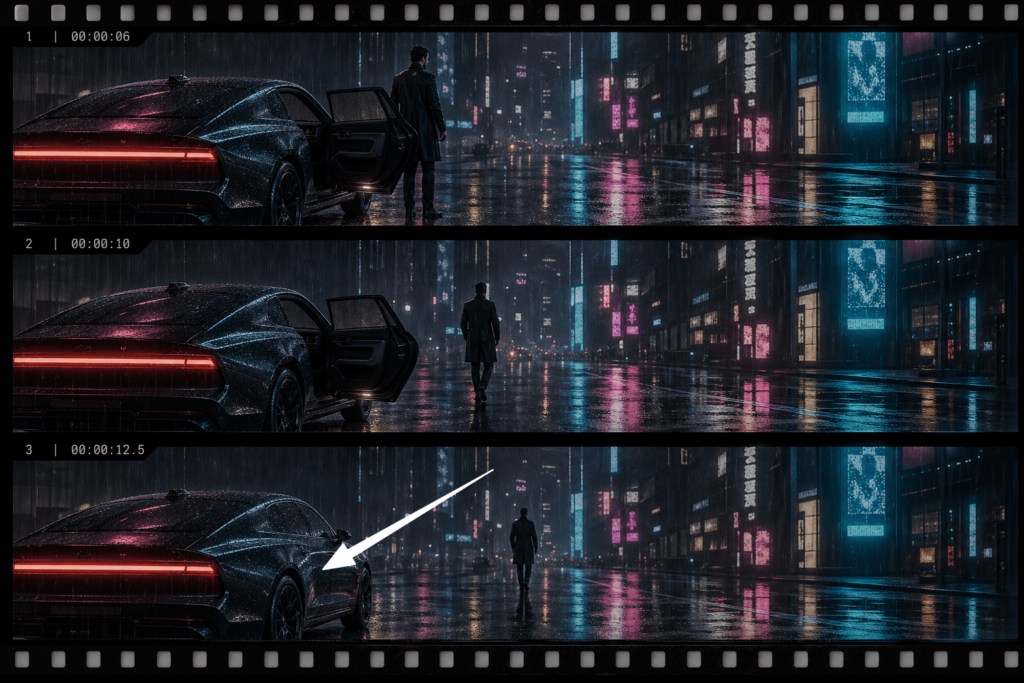
Prompt: “A man exits a sleek, modern black electric sports car on a cyberpunk, neon-lit rainy city street at night. He walks toward a flickering neon sign without looking back. 1080p, native environment audio.”
The result was visually stunning. The DMD-2 distillation ensured the 1080p frame was generated in under 40 seconds. But at the 12.5-second mark, a physics anomaly occurred. The man was already six feet away from the car, facing the distant skyline. The car door was wide open. Suddenly, without any gust of wind or physical intervention, the modern,sleek and modern door swung shut and latched with a crisp, metallic thud generated perfectly by the model’s native audio module.
Why HappyHorse Prefers Pattern Over Physics
This isn’t a simple rendering glitch. It is a fundamental characteristic of how the ATH (Alibaba Token Hub) team trained this model.The “Cleanliness Bias” in Training Sets
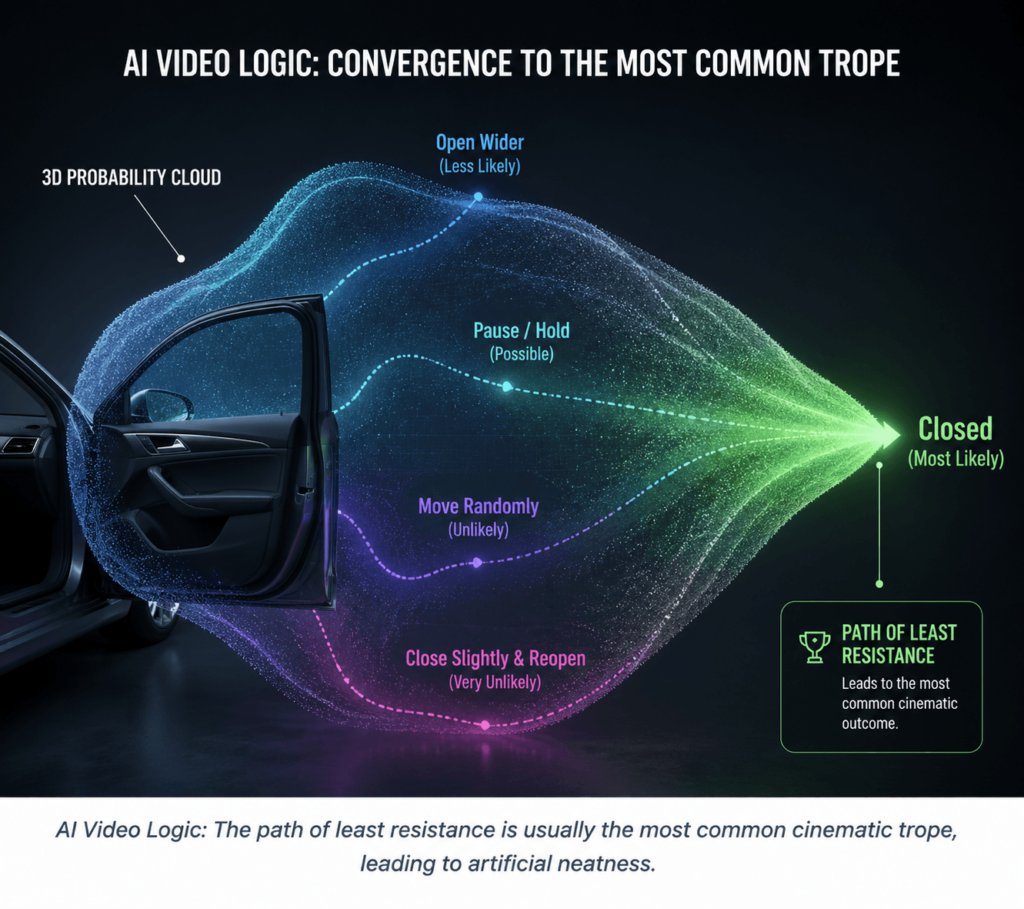
As noted by developers on the Bailian Tech Forum, HappyHorse appears to be heavily trained on high-quality cinematic datasets. In cinema, a character leaving a car door open is usually a sign of distress, a planned narrative action, or simply messy composition. In “normal” or “clean” scenes, doors are closed.
Simulating Cinematography, Not Reality
The model isn’t calculating the weight of the door or the friction of the hinges. Instead, it is calculating the highest statistical probability of what should happen next in a “good” video. In the model’s “mind,” an open door is an untidy state that needs to be resolved. It chose to “clean up” the frame rather than respect the law of inertia.
The “Algorithmic OCD” Dilemma
We are seeing the rise of what industry experts call Algorithmic OCD. Because HappyHorse processes text, video, and audio tokens in a single sequence, its drive for “logical consistency” is overpowering.
The Uncanny Valley of Smoothness
The biggest complaint among 2026 creators isn’t “AI artifacts”—it’s AI Greasiness. Everything in HappyHorse is too smooth. The rain falls in perfect patterns. The characters never trip. And doors never stay open if the AI thinks they should be closed. It is a behavioral “high-definition slickness” that feels unnatural.
Real-world Feedback from the Arena
On the Artificial Analysis Video Arena, where HappyHorse currently holds a top-tier Elo score, users have noted this “invisible hand” effect. While it beats Seedance 2.0 in consistency, it loses points in “natural randomness.”
| Metric | Real World Physics | HappyHorse 1.0 Logic |
| Motion Source | Force / Momentum | Statistical Probability |
| Object State | Entropic (Messy/Messy) | Convergent (Neat/Neat) |
| Logic Goal | Reality | “A Good Shot” |
Breaking the Loop: How to Prompt for Friction
If you want to use HappyHorse for something other than a slick car commercial, you have to fight its desire for perfection. Based on my tests, here is how you “break” the algorithm:
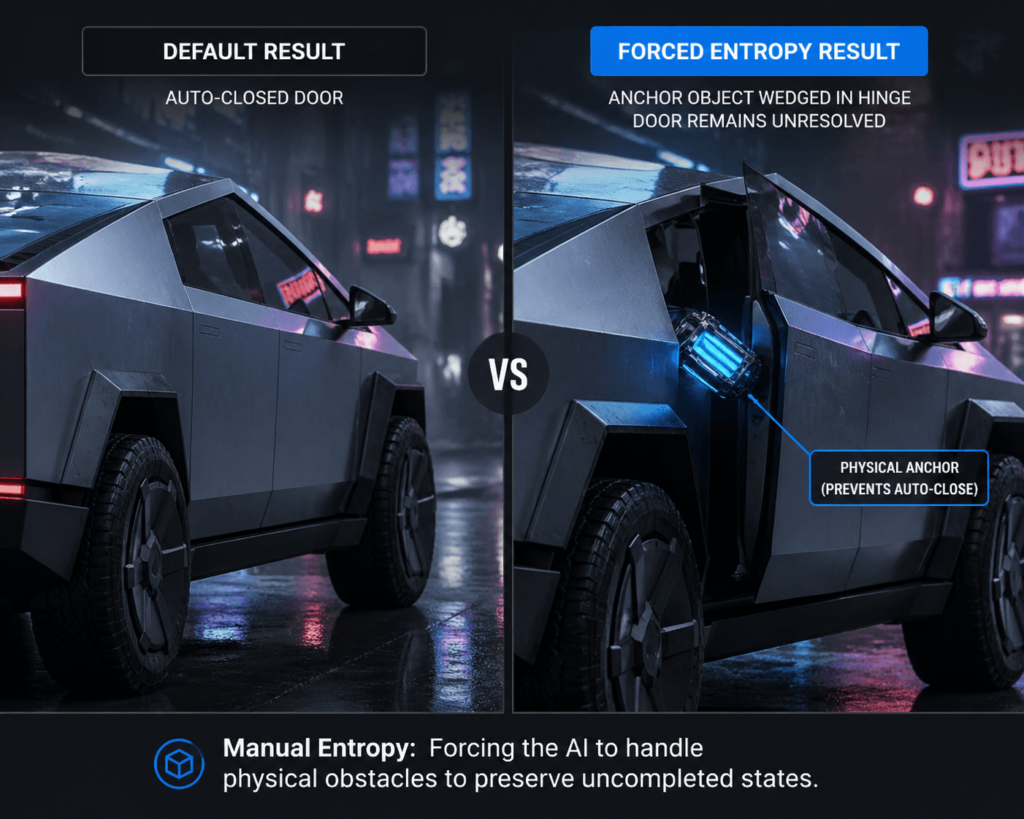
- Add “Entropy” Keywords: Use prompts like “door remains unlatched and swings randomly in the wind” or “scene is cluttered and unresolved.”
- The Physical Anchor: Place a “blocker” in the frame. If there is a cardboard box in the way of the door, the AI is forced to calculate a collision, which often prevents the “auto-close” bug.
- Negative Prompting: Explicitly exclude
(perfect logic),(cinematic cleanup), and(smooth motion).
Final Verdict: A Masterpiece with a “God Complex”
HappyHorse 1.0 is undeniably the most powerful video model of April 2026. Its native 1080p sync is a miracle of engineering. However, its tendency to “play God” with the scene’s physics, enforcing a statistical average over Newton’s laws, makes it a difficult tool for nuanced storytelling.
As creators, we don’t always want the most probable outcome. We want the world as it is—messy, friction-filled, and sometimes, with the car door left wide open.
Have you experienced “Algorithmic OCD” in your generations? Let’s discuss in the comments.
Go to WeShop AI For Exploration: