AI Video content is exploding everywhere.
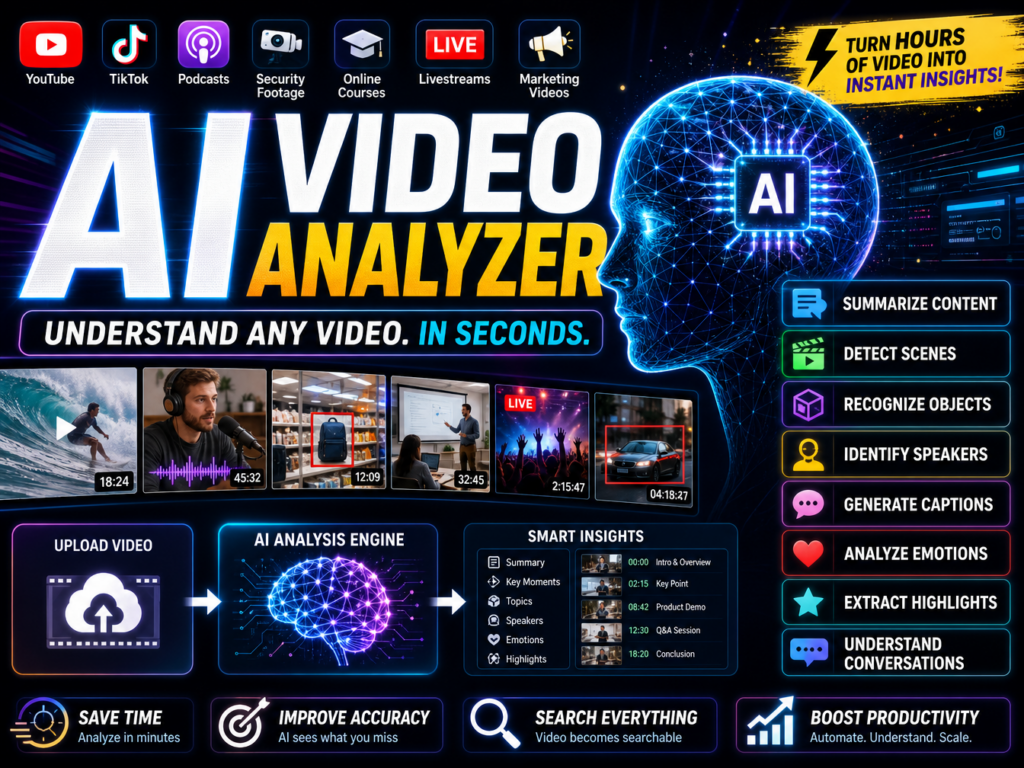
Every day, people upload massive amounts of:
- YouTube videos
- TikToks
- podcasts
- security footage
- online courses
- livestreams
- marketing videos
The problem is no longer access to video.
The problem is understanding it quickly.
Watching hours of footage manually is slow, expensive, and increasingly unrealistic. That is exactly why AI video analyzer tools are becoming one of the fastest-growing areas in artificial intelligence.
Instead of simply “watching” videos, modern AI systems can now:
- summarize content
- detect scenes
- recognize objects
- identify speakers
- generate captions
- analyze emotions
- extract highlights
- understand conversations
And honestly, the technology is improving shockingly fast.
🎥 What Is an AI Video Analyzer?
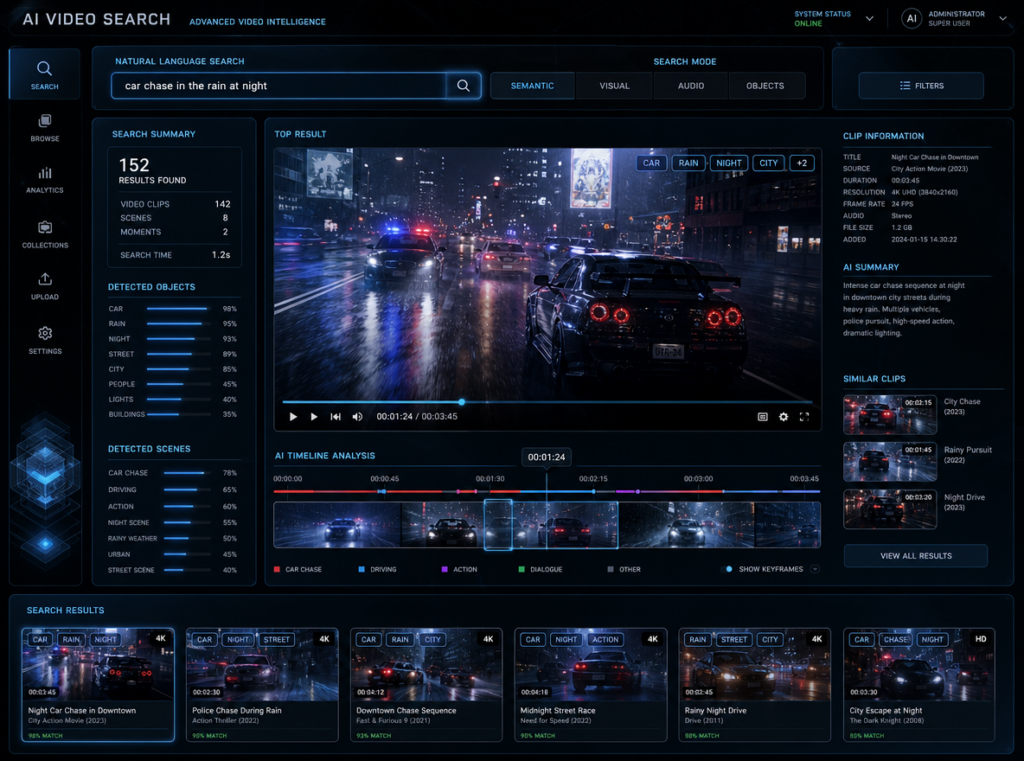
An AI video analyzer is a tool that uses artificial intelligence to automatically understand and process video content.
Instead of manually reviewing footage, users can upload videos and let AI extract important information automatically.
Depending on the platform, AI video analyzers can perform tasks such as:
- speech transcription
- scene segmentation
- facial recognition
- object detection
- subtitle generation
- sentiment analysis
- clip recommendations
- content moderation
Some advanced systems can even answer questions about a video directly.
For example:
“What happened at the beginning of the video?”
“Which products appeared most often?”
“Summarize this meeting in 30 seconds.”
That changes how people interact with video completely.
🚀 Why AI Video Analyzers Are Suddenly Everywhere
Several things accelerated the growth of AI video analysis tools.
First, video content became overwhelming.
Second, multimodal AI models improved dramatically.
Third, businesses realized video contains enormous amounts of searchable information.
Today, companies use AI video analyzers for:
- marketing analytics
- security systems
- ecommerce videos
- online education
- social media automation
- meeting summaries
- sports analysis
- customer support
The market is expanding incredibly quickly because almost every industry now relies heavily on video.
🧠 How AI Video Analysis Actually Works
Most AI video analyzers combine multiple AI systems together.
These systems often include:
- computer vision
- speech recognition
- large language models
- audio analysis
- motion tracking
The AI first breaks a video into smaller components.
Then it analyzes:
- frames
- objects
- voices
- text
- movement
- scene changes
Finally, the system organizes all that information into searchable insights.
Modern AI models can now understand not only what appears visually, but also what is happening contextually.
That is the real breakthrough.
🔥 Best AI Video Analyzer Tools Right Now
📹 Google Gemini Video Analysis
Google continues pushing multimodal AI aggressively through Gemini.
Gemini’s video understanding capabilities are becoming increasingly powerful because the model can process:
- visuals
- audio
- spoken language
- contextual meaning
simultaneously.
This allows surprisingly accurate video summaries and question-answering workflows.
Gemini performs especially well for:
- educational videos
- long-form content
- meeting analysis
- research workflows
⚡ ChatGPT Video Analysis Workflows
OpenAI is rapidly expanding multimodal AI capabilities through ChatGPT and related tools.
Although ChatGPT is not positioned purely as a dedicated “video analyzer,” creators increasingly use it alongside:
- transcripts
- screenshots
- video uploads
- timeline summaries
to analyze content quickly.
This workflow has become especially popular for:
- YouTube creators
- researchers
- marketers
- students
- podcast editors
The biggest strength is flexibility.
Instead of only detecting objects, the AI can reason about the content itself.
🎬 Runway AI
Runway focuses heavily on AI video workflows and creative automation.
The platform combines:
- video editing
- scene understanding
- object tracking
- AI generation
- motion analysis
inside a creator-focused ecosystem.
Because of this, Runway has become extremely popular among:
- filmmakers
- TikTok creators
- AI artists
- social media teams
The interface also feels far more visual and creative compared to enterprise AI systems.
👀 Opus Clip
Opus Clip became viral because it solves one huge problem:
Turning long videos into short viral clips automatically.
The AI analyzes:
- emotional moments
- engagement potential
- speaking intensity
- topic changes
Then it generates TikTok-style clips optimized for social media.
This dramatically reduces editing time for creators.
And honestly, many creators now rely on tools like this daily.
🛡 AI Video Analysis for Security and Surveillance
One of the biggest enterprise use cases is security footage analysis.
Modern AI systems can detect:
- unusual movement
- abandoned objects
- crowd behavior
- suspicious activity
- license plates
- faces
much faster than human teams.
This allows companies to monitor massive amounts of footage more efficiently.
However, this area also raises serious privacy concerns.
As AI video analysis improves, debates around surveillance and facial recognition will likely intensify significantly.
📈 Why AI Video Search Changes Everything
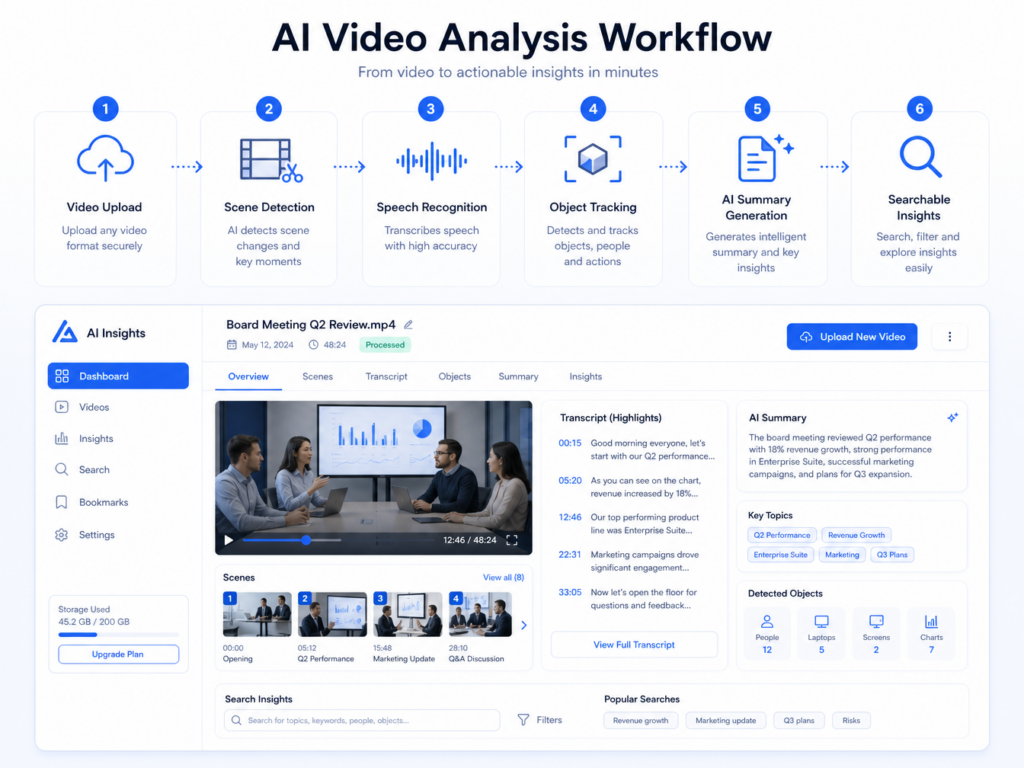
Perhaps the biggest long-term shift is searchable video.
Traditionally, videos were difficult to search deeply.
You could search titles or captions, but not the actual visual content itself.
AI changes that completely.
Soon, users may search videos using prompts like:
- “Find every scene with a red car”
- “Show emotional moments from this podcast”
- “Locate all product mentions”
That transforms video into something much closer to searchable data.
This could fundamentally reshape:
- education
- entertainment
- advertising
- enterprise knowledge systems
⚠ Problems AI Video Analyzers Still Struggle With
Despite rapid progress, AI video analysis still has major limitations.
Current systems can struggle with:
- sarcasm
- emotional nuance
- fast scene transitions
- overlapping voices
- complex storytelling
- context ambiguity
Additionally, hallucinations remain a real issue.
Some AI systems confidently describe events that never actually happened in the footage.
That becomes dangerous in high-stakes environments like security, journalism, or legal review.
💡 Why AI Video Analysis Will Become Normal
Right now, AI video analysis still feels futuristic.
However, that probably will not last long.
As video becomes the dominant form of online content, AI tools that organize and understand video will become increasingly necessary.
Eventually, manually reviewing large video libraries may feel as outdated as manually sorting thousands of photographs by hand.
That shift is already starting.
Final Thoughts
AI video analyzer tools are evolving from simple transcription systems into full multimodal understanding platforms.
The technology can already summarize videos, identify objects, generate clips, analyze conversations, and organize massive amounts of footage automatically.
As multimodal AI improves further, video may become fully searchable, interactive, and context-aware.
And honestly, that could change the internet more than most people realize.
Go to WeShop AI For Exploration: