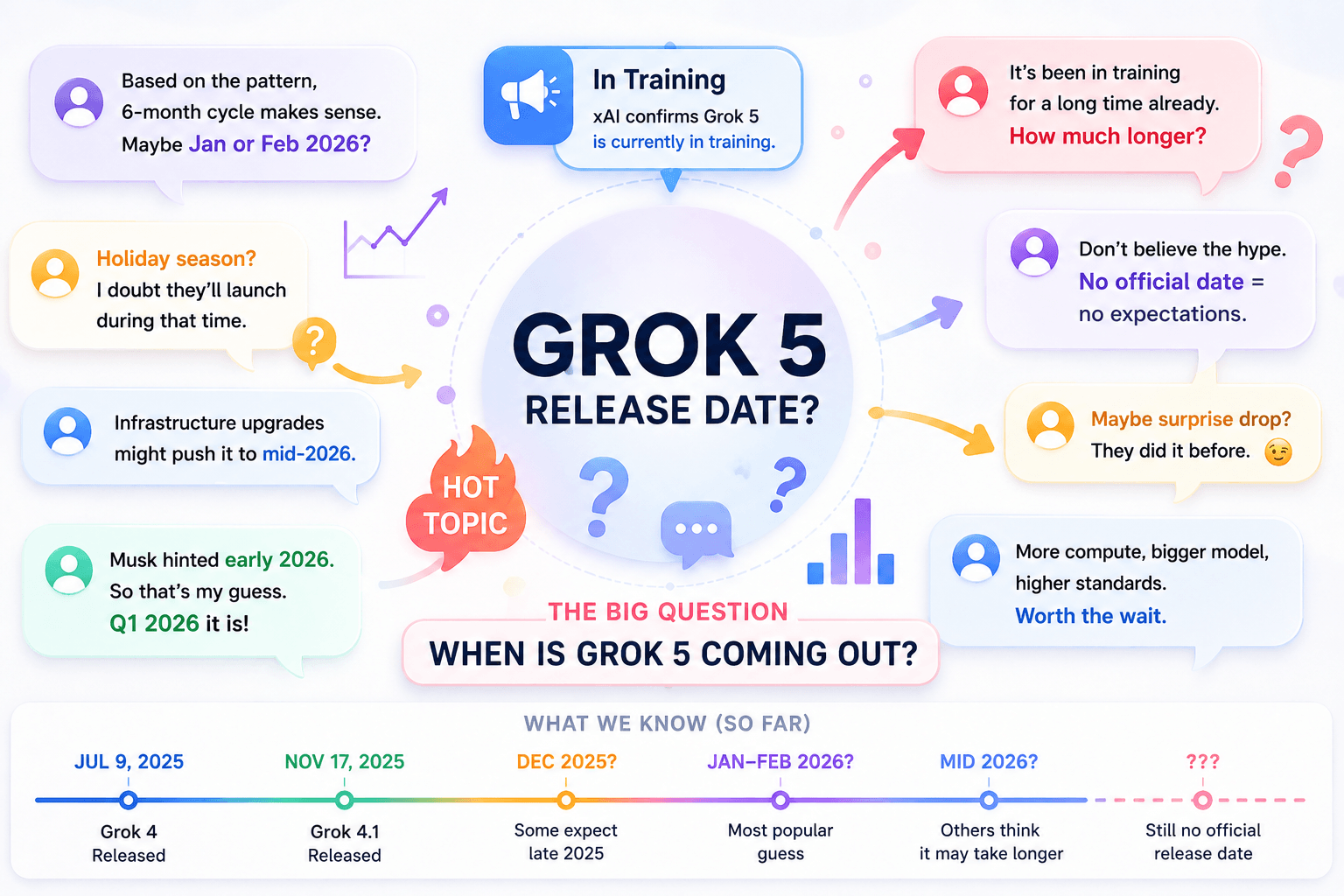
People keep asking the same question: when is Grok 5 coming out?
It is a fair question. In the AI world, release dates tend to carry more weight than they should. A launch is never just a launch. It becomes a signal about progress, pressure, competition, and where a company thinks it stands in the race.
But with Grok 5, the more interesting answer is not a specific day on the calendar. It is the fact that xAI has not announced one yet. The company has only said that Grok 5 is in training, which leaves plenty of room for speculation but not much room for certainty.
That is why this story is worth paying attention to. Grok 5 is no longer just another unreleased model people are waiting on. It has become a kind of shorthand for xAI’s next move — a way to gauge how fast the company is building, how far its infrastructure has come, and how seriously it wants to compete at the frontier.
So yes, people are looking for a release date. But the real story is what that missing date suggests.
What xAI Has Actually Confirmed
At this point, there is still no official public release date for Grok 5.
What xAI has made clear is that the model is in training. That is useful, but it is not the same as a launch announcement. There is no confirmed beta window, no public rollout schedule, and no official count-down to watch.
Still, the absence of a date does not mean the topic is empty. In AI, silence often means the company is still working through the messy parts: training stability, deployment readiness, product packaging, and the much less glamorous business of making sure a model can actually scale.
That is why release timing matters so much. A model does not appear out of nowhere. Before a major launch, there are usually signs: changes in product tiers, shifts in documentation, infrastructure upgrades, or subtle wording changes in official communication.
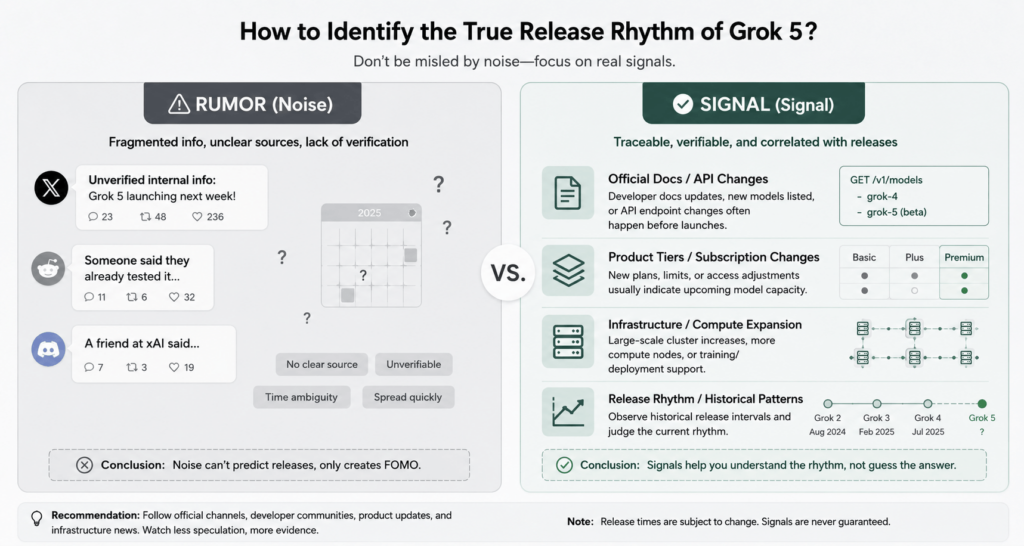
If you are trying to understand Grok 5, those signals may matter more than rumors.
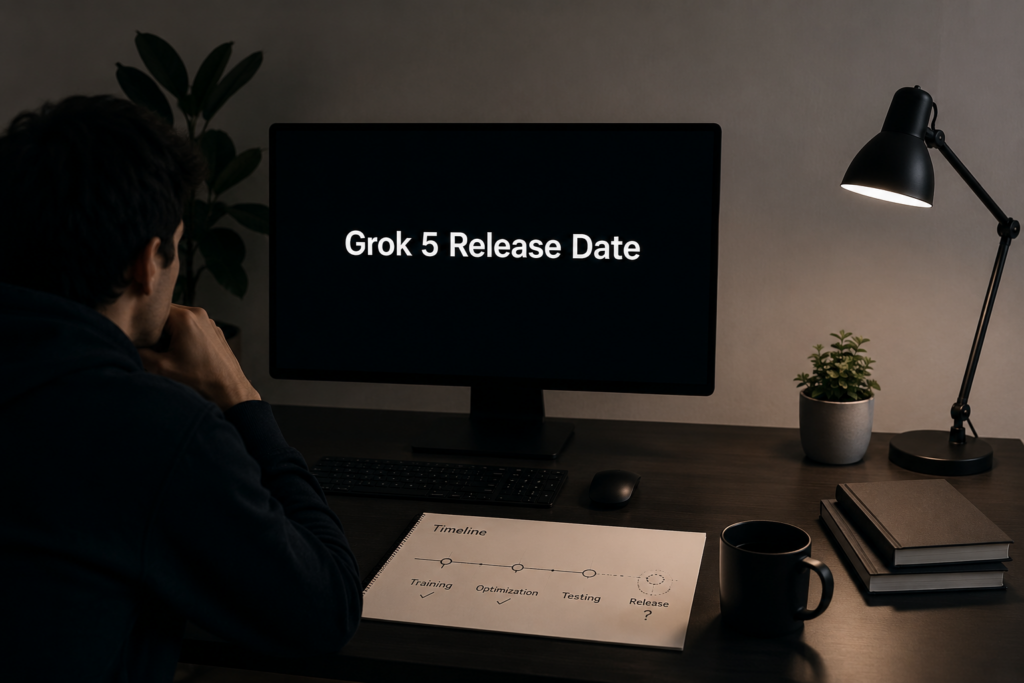
Why People Care So Much About the Date
The obsession with a release date is rarely only about timing. More often, it is about what that timing represents.
Every major AI launch has become a public test of momentum. When a company like OpenAI, Google, Anthropic, or xAI releases a new model, people immediately try to decode what it says about capability, scale, and strategy. The date itself becomes part of the narrative.
Grok 5 is especially sensitive in that regard because xAI does not behave like a traditional AI lab. It is tied closely to social media culture, fast-moving product cycles, and a broader ecosystem that already knows how to generate attention. That combination makes every rumor travel faster than it probably should.
There is also a practical reason the launch matters. In frontier AI, release timing is often linked to infrastructure maturity rather than marketing plans. A model may be technically impressive long before it is ready to ship. It still has to be tested, optimized, priced, deployed, and integrated into something people can actually use.
So when people ask for the Grok 5 release date, what they are really asking is: how close is xAI to turning training progress into a real product?
That is a much more interesting question.
The 3 Signals That Matter More Than Rumors
If you want to follow Grok 5 closely, the smartest move is not to chase every rumor. It is to watch the signals that usually show up before a real launch.
Signal 1 — Product Packaging Changes
One of the earliest clues is often the product itself.
When a company is preparing a major model release, it usually starts adjusting the surrounding experience first. That can mean new subscription tiers, new access levels, changes in feature names, or a reshuffling of what sits behind a paywall.
These are not dramatic changes on their own, but they matter because they show that the company is making room for something larger.
If xAI begins reorganizing how Grok is packaged or accessed, that is a stronger sign than any unverified post claiming a launch is “imminent.”
Signal 2 — Documentation and Model References
A second clue usually comes from the technical side.
Developers often notice unreleased models before the public does. New API references, hidden aliases, staging documentation, and experimental endpoints have all served as early indicators of upcoming launches in the AI space.
That is because the backend often changes before the front-end story does. By the time an official announcement arrives, the technical groundwork has usually been in motion for a while.
For that reason, anyone seriously tracking Grok 5 should pay attention to developer-facing changes, not just headline chatter.
Signal 3 — Infrastructure Language
The third signal is more subtle, but arguably the most important: how xAI talks about infrastructure.
When AI companies start talking more openly about training scale, compute expansion, deployment capacity, and long-term infrastructure investment, they are often preparing the market for the next phase of model development.
That matters because frontier AI is increasingly a compute story. Great marketing helps, but it does not replace the reality of training cost, inference efficiency, and deployment scale.
So if xAI keeps emphasizing infrastructure and expansion, that tells you something real about how it is thinking about Grok 5.
What a Real Grok 5 Launch Would Actually Change
A lot of people assume the biggest impact of Grok 5 would be better benchmark numbers.
Maybe it will be better. Most likely, it will be. But the more interesting change may happen somewhere else.
For creators, a new model can shift how work gets done. It can change how fast ideas turn into drafts, how quickly rough concepts become usable assets, and how much manual cleanup is still needed at the end of a workflow. For developers, it can affect pricing, latency, access, and the kinds of things they can automate without building a full custom stack.
That is what makes a launch meaningful: not just the model itself, but the way it changes what people can do with it.
For xAI, Grok 5 is also about credibility. Each new release is a public demonstration of whether the company is moving forward in a serious way or simply keeping pace. In a market this crowded, momentum matters almost as much as capability.
That is why the release date has become such a focal point. It is not because people need a calendar reminder. It is because the timing says something about the company’s direction.
So, When Should People Start Paying Attention?
The honest answer is that exact predictions are not very useful right now.
Instead of waiting for a rumored date, it makes more sense to watch for a cluster of signs: product changes, documentation updates, infrastructure announcements, new access tiers, or changes in how xAI talks about upcoming models.
Those are the moments when a launch starts to feel real.
In AI, the final announcement usually arrives after the groundwork has already been laid. By then, the important story is not whether the model exists. It is how long it has been preparing to become public.
And that is the best way to think about Grok 5 right now.
Not as a date.
As a direction.
Go to WeShop AI For Exploration: