If you work in ecommerce, you already know that visuals are not just decoration. They are part of the sales process. A product image has to do more than look good. It has to help people understand the product, trust the brand, and move one step closer to buying.
That is why the question of which AI image model is “best” for ecommerce is not as simple as it sounds. Different models solve different problems. Some are better for mood and storytelling. Some are better for product accuracy. Some are better for text-heavy promotions. Some are better for commercial safety and team workflows.
The most useful way to think about AI image models is not as a single ranking, but as a set of tools for different ecommerce tasks.
What Ecommerce Brands Need From AI Image Models
Ecommerce teams do not need the same kind of image every time. Sometimes the goal is to create a polished lifestyle scene that makes the product feel aspirational. Sometimes the goal is to produce a fast ad variation for testing. Sometimes the goal is to create a sale banner with readable text. And sometimes the job is simply to edit an existing product photo so it can be reused in a new campaign.
That means the best AI image model is not always the most visually impressive one. It is the one that gives you the most usable output for the least amount of work.
Product Consistency Matters More Than Style
For ecommerce, consistency is critical. If you are selling one product in different colors, angles, or settings, the model needs to preserve the product identity across variations. A visually striking result is not very helpful if the model keeps changing the shape, texture, or details of the item.
That is one of the biggest differences between casual image generation and ecommerce use. In ecommerce, the image must still feel like the same product.
Campaign Visuals Need Brand Emotion
At the same time, ecommerce is not only about clean catalog images. Brands also need emotional visuals. A great campaign image can make a product feel more premium, more desirable, or more memorable. That is especially important for fashion, beauty, lifestyle, and home brands.
This is where some models stand out more than others. A model that creates atmosphere and visual drama may be ideal for brand storytelling, even if it is not the most precise for product repetition.
Text and Layout Can Make or Break Performance
A lot of ecommerce visuals need text. Sale banners, launch posts, seasonal ads, and promotional graphics often depend on readable copy. If the model cannot handle typography well, the result may look interesting but still be unusable.
That is why text rendering is more than a design detail. For ecommerce, it is a practical requirement.
Editing Existing Images Is Often More Useful Than Generating From Scratch
In real workflows, teams often already have a good product image. They just need to change the background, update the setting, improve the lighting, or create a new version for a campaign.
This is an important point because it changes how you evaluate a model. A tool that is great at full generation may still be less helpful than a tool that is strong at editing and refinement.
Commercial Safety Matters for Real Business Use
For businesses, creative quality is only one part of the decision. The other part is whether the output fits commercial use, brand rules, and internal approval processes. Some teams need tools that feel easier to defend legally and operationally.
That is why the best model for ecommerce is not always the most experimental one. Sometimes it is the one that fits the business environment most smoothly.
Midjourney for Brand Mood and Visual Direction
Midjourney remains one of the strongest tools when the goal is visual style. It is especially useful for brand moodboards, premium-looking scenes, fashion campaigns, beauty storytelling, and highly polished lifestyle imagery.
For ecommerce, that makes Midjourney a strong choice near the top of the funnel. It is excellent when you want the product to sit inside a world that feels aspirational or cinematic. A brand that wants to look elevated will often find Midjourney especially useful.
Best for Luxury, Fashion, and Lifestyle Imagery
Midjourney works particularly well when the goal is to create a feeling rather than a strict product replica. That makes it very attractive for brands in fashion, beauty, wellness, home decor, and premium consumer goods.
It is often strongest when the creative brief is broad and emotionally driven. If the goal is to inspire a direction, Midjourney can produce images that feel far more polished than a simple functional render.
Where Midjourney Still Struggles for Ecommerce Workflows
The tradeoff is control. For ecommerce, control matters a lot. If you need the same product to stay stable across many outputs, Midjourney may require extra attention and more manual filtering. It can be powerful, but it is not always the most efficient tool for production-heavy workflows.
That is why Midjourney is often best used as a visual direction tool rather than a final production engine.
OpenAI Image Models for Controlled Ecommerce Output
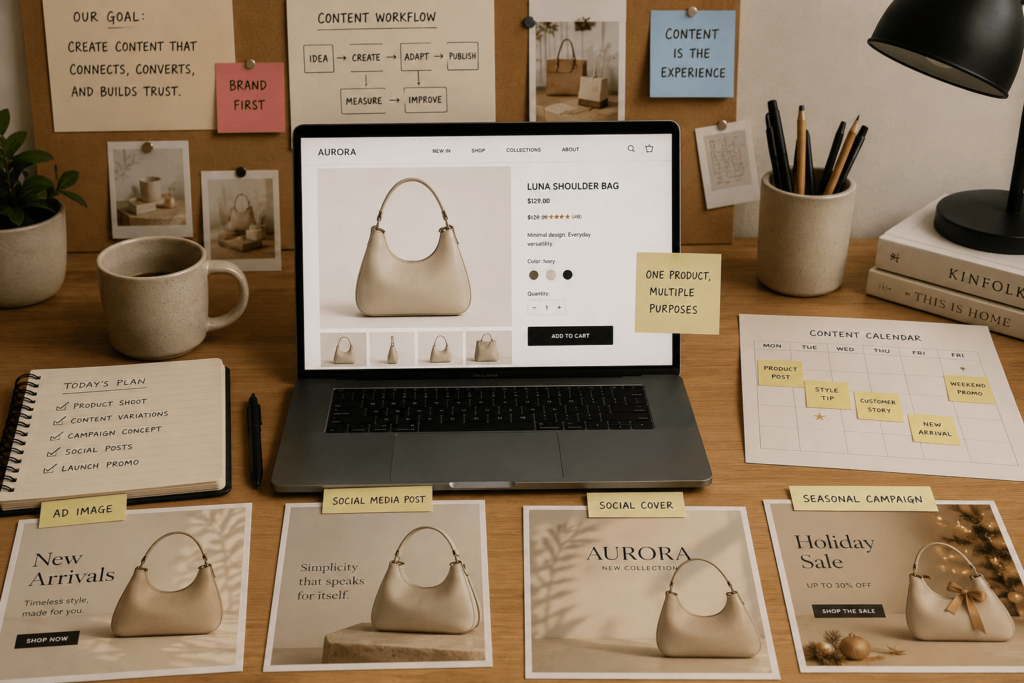
OpenAI image models are a strong fit for ecommerce because ecommerce often needs clarity more than surprise. The workflow is usually about creating usable images, producing variations, making edits, and maintaining consistency across a growing set of assets.
That makes OpenAI image models especially valuable for practical creative work. They are useful when the output needs to serve a business process instead of just looking impressive on its own.
Best for Product Ads and Practical Creative Workflows
One of the biggest strengths of OpenAI image models is that they fit real production logic. A team can use them to create ad creatives, simple campaign visuals, mockups, and edited product images without needing to overcomplicate the process.
For ecommerce, that kind of reliability is extremely useful. It saves time, reduces cleanup, and makes creative testing easier.
Why Controllable Output Matters for Ecommerce Teams
Ecommerce content is rarely a one-time project. It is an ongoing system of iteration. Teams need to generate many variations, test what performs, and keep moving. In that environment, a model that gives controllable output is often more valuable than one that creates the most dramatic image.
This is where OpenAI image models stand out. They are especially useful when the team needs something closer to a production tool than a pure art generator.
Ideogram for Typography and Promotional Graphics
Ideogram has a very clear advantage in one of the hardest areas of AI image generation: text. For ecommerce, that matters more than many people expect.
A lot of ecommerce creatives are not just images. They are images plus copy. Sale campaigns, launch banners, social posts, and promotional graphics all depend on text that looks clean and readable.
Best for Banners, Sale Creatives, and Launch Assets
Ideogram is especially useful when the image itself needs to carry a message. That makes it a strong fit for seasonal campaigns, discount graphics, launch announcements, and social creatives that need a clear headline or offer.
If the asset needs to be published quickly and look polished without a designer spending extra time fixing the typography, Ideogram becomes a very practical choice.
Why Text Handling Is a Major Advantage
In ecommerce, the most beautiful image is not always the most useful one. A banner that looks sleek but cannot communicate the offer is not doing its job. Ideogram helps solve that problem by making typography a core strength rather than an afterthought.
That is a major reason to include it in an ecommerce image stack. It is not just a generator. It is a production-friendly tool for marketing graphics.
Adobe Firefly for Commercial-Safe Marketing
Adobe Firefly is especially appealing for teams that care about commercial safety and brand approval. For larger businesses, this can matter as much as creative quality.
Many ecommerce teams do not work in a vacuum. They work with legal, brand, and marketing stakeholders. A tool that fits those requirements more easily often has a real advantage.
Best for Enterprise Brands and Approved Workflows
Firefly is a strong option when the output needs to move through an internal review process. That makes it useful for enterprise ecommerce teams, branded marketing departments, and companies that need a safer creative workflow.
In that setting, the value of the tool is not just what it generates. It is how easily the generated work can be used inside a real company.
Why Commercial Safety Matters in Ecommerce
For ecommerce, trust is part of the product. Customers need to trust the brand, but the brand team also needs to trust the workflow. Firefly offers a cleaner fit for organizations that want to reduce uncertainty around commercial use.
It may not always feel like the most adventurous creative tool, but that is also why some teams prefer it.
Which AI Image Model Is Best for Each Ecommerce Task
The most useful answer is not one model. It is a task-based choice.
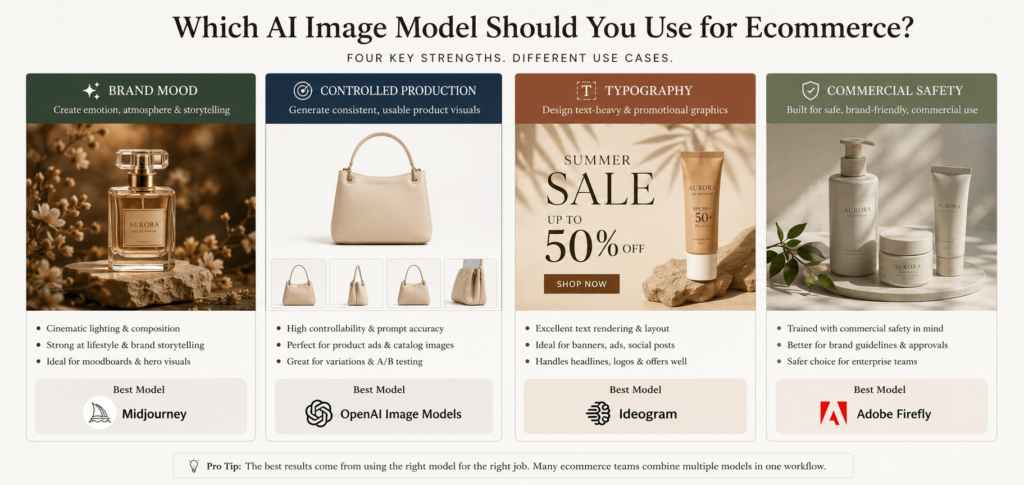
If the goal is brand mood, Midjourney is often the strongest option. If the goal is controlled ecommerce production, OpenAI image models are often the most practical. If the goal is typography-heavy promotional graphics, Ideogram has a clear advantage. If the goal is brand-safe commercial work, Firefly is a strong fit.
That is why comparing these models as if they all do the same job is misleading. They do not. They solve different parts of the ecommerce workflow.
Best for Brand Mood
Midjourney is a strong choice when the image needs atmosphere, style, and visual emotion.
Best for Production-Ready Ecommerce Visuals
OpenAI image models are especially useful when the output needs to be controllable, practical, and easy to use in a workflow.
Best for Text-Heavy Creatives
Ideogram is the model to look at when the image needs clean typography and promotional clarity.
Best for Commercial Safety
Adobe Firefly is well suited to teams that need a more brand-safe and enterprise-friendly option.
Why Ecommerce Teams Should Use Multiple AI Image Models
The biggest mistake in AI image review content is pretending that one model should solve everything. That is not how ecommerce works.
Ecommerce is a workflow problem. Different stages of the workflow need different strengths. One model may be great for ideation, another for production, another for typography, and another for safe commercial delivery.
One Model Cannot Do Every Job Well
A model that is amazing at visual drama may not be the best at repeatable product consistency. A model that is strong at typography may not be the best at rich lifestyle imagery. A model that is safe for business may not be the most experimental.
That does not mean any of them are bad. It means they are specialized.
Workflow Matters More Than Ranking
The smartest ecommerce teams are not trying to crown one winner. They are building a workflow that combines the strengths of multiple tools.
That approach is much more realistic. It also leads to better results, because each model is used for the kind of work it actually handles best.
The Best Teams Choose Tools by Task
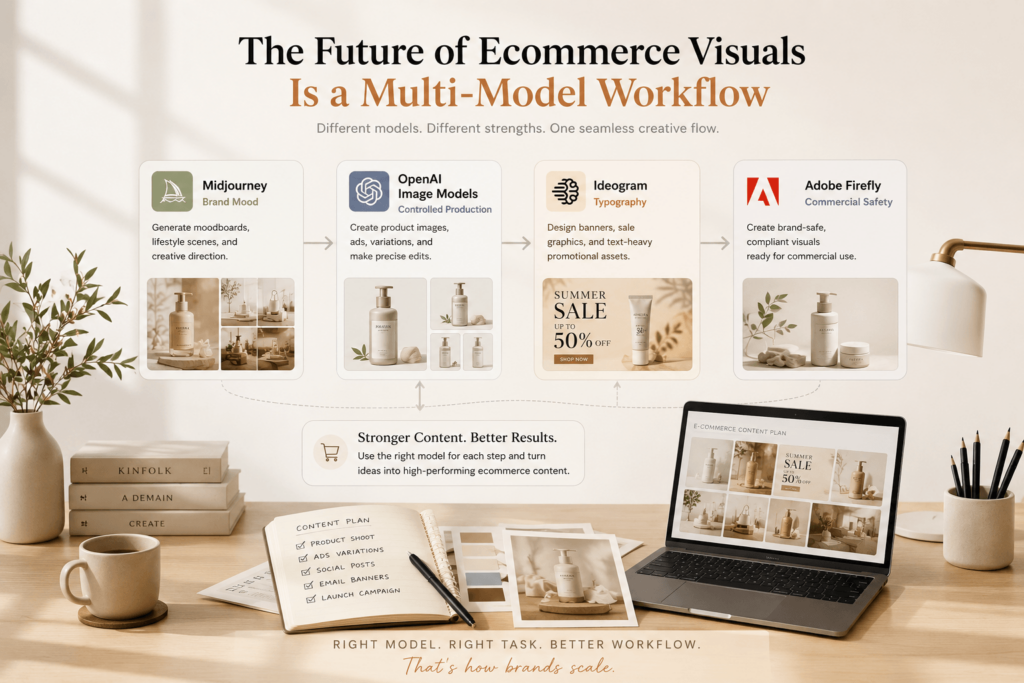
A practical ecommerce stack might look like this: use Midjourney for mood and direction, OpenAI image models for controlled creative output, Ideogram for text-heavy promotional assets, and Firefly for commercial-safe brand work.
That is not overcomplicating things. That is simply using the right tool at the right stage.
Final Verdict
There is no single best AI image model for ecommerce.
The best model depends on the job.
If you need emotional brand imagery, Midjourney is a strong choice. If you need controlled production visuals, OpenAI image models are especially compelling. If you need readable promotional graphics, Ideogram stands out. If you need commercial safety, Firefly has a clear place in the stack.
The future of ecommerce visuals is not one model replacing all others. It is a smarter workflow made from several models, each handling the task it does best.
That is the real answer.
Go to WeShop AI For Exploration: