









Create an Isometric Cutaway Illustration with Nano Banana 2.1
Create a miniature library cutaway from text with Nano Banana 2.1, using a tested prompt and checks for camera, open walls, layout, and object counts.
A miniature room is easier to read when the roof and front walls are out of the way. In this Nano Banana 2.1 test, a written library brief became an open cutaway with walnut bookshelves, a green reading chair, and a round table—all visible in one square image.
This workflow is for illustrators and designers making a small scene for an editorial, a mood board, or a fictional world. The deliverable is an AI-generated 2D illustration with a miniature diorama look. It does not produce a measured floor plan or an editable 3D model.
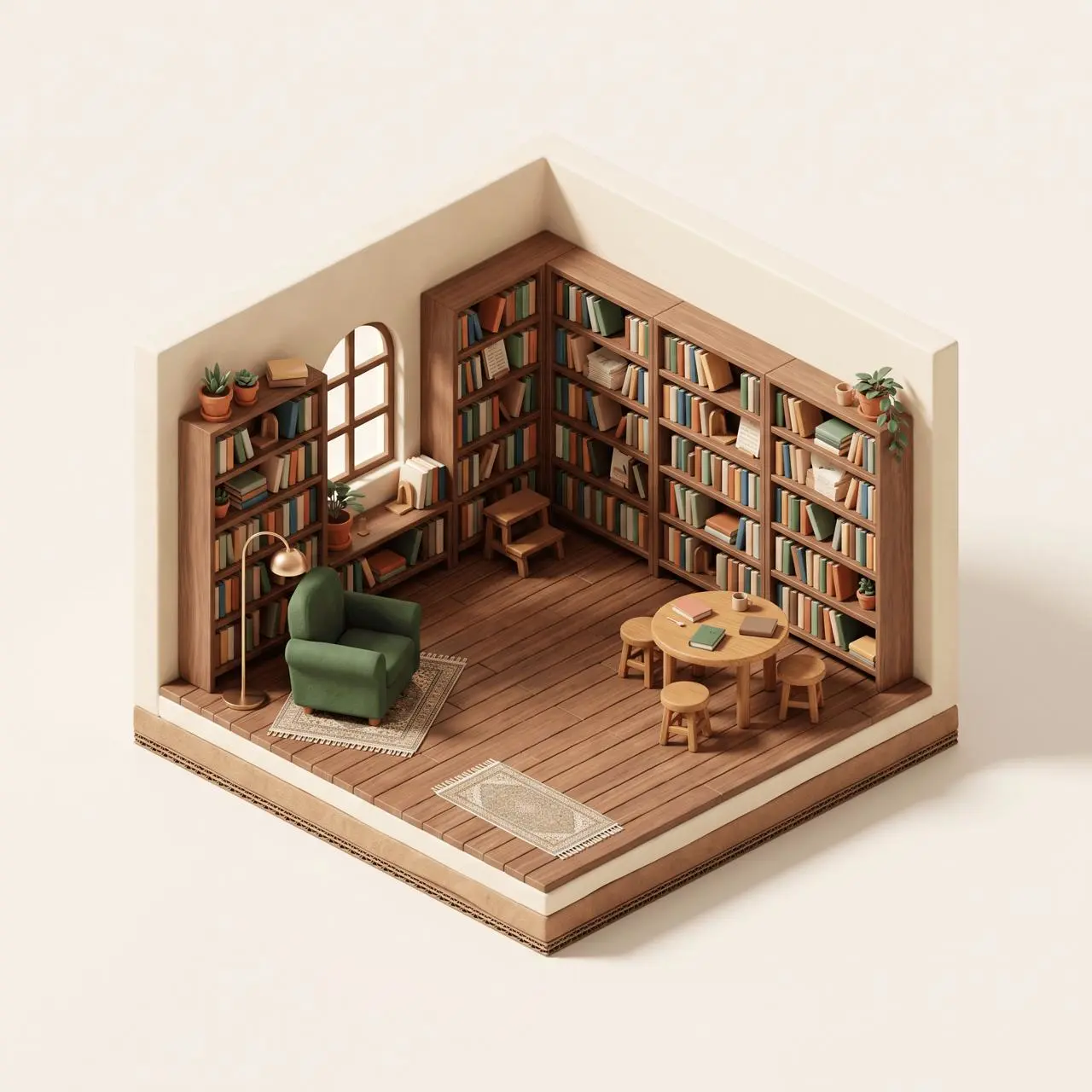
Generated result: the open front reveals the reading area and shelves. The image also shows why object counts need a separate check.
Define the cutaway before decorating the room
Give the model a spatial brief before listing attractive details. For this scene, five decisions matter:
- View: an isometric-style, orthographic view from above, with parallel verticals.
- Opening: remove the roof and both front-facing walls; keep the two rear walls.
- Boundary: one square room on a thick base, with the entire base in frame.
- Layout: bookshelves around the back, reading chair on the left, table on the right, and a clear middle.
- Finish: warm ivory, walnut, green upholstery, and soft light against an uncluttered background.
The camera and opening instructions describe how the reader should see the space. The furniture positions give that space a hierarchy. Material and lighting details then establish the handcrafted mood.
Generate the miniature library in WeShop
Open the Nano Banana generator and select Nano Banana 2.1 in the Model menu. Check the version explicitly: the tool also lists other Nano Banana models.
Leave the optional image input empty for this example. It starts from text and does not require a photograph or sketch. Use these tested settings:
| Setting | Tested value |
|---|---|
| Model | Nano Banana 2.1 |
| Aspect Ratio | 1:1 |
| Image Size | 2K |
| Quantity | 1 |
| Reference image | None |
Paste the full prompt below, then click Generate. The selected output was 2048 × 2048 pixels. These settings describe this run; they are not a claim that every room illustration needs the same resolution.
Copy the tested cutaway prompt
Create one isometric cutaway illustration of a tiny neighborhood library as a handcrafted miniature diorama. Orthographic view from above at a 30-degree angle, parallel verticals, no wide-angle distortion. Remove the roof and both front-facing walls so the interior is completely visible; retain the two rear walls. One single square room on a thick square base. An L-shaped wall of walnut bookshelves follows the two rear walls; a forest-green reading armchair and brass floor lamp sit on the left; one round oak table with two stools sits on the right; a small arched window is centered on the back wall. Leave a clear walking path through the middle. Warm ivory plaster, walnut wood, green upholstery, terracotta accents, tiny books with blank spines, soft clay-like materials and fine paper texture. Soft afternoon light from upper left, gentle ambient occlusion, clean warm off-white background, whole base visible with generous breathing room. Cozy editorial illustration, precise readable shapes. No people, no letters, no labels, no watermark, no extra rooms, no exterior street.
The prompt deliberately limits the scene to one room and keeps the surrounding background empty. It also asks for blank book spines so the image does not depend on readable titles. For a broader approach to writing briefs, see the Nano Banana 2.1 prompt guide.
Inspect the structure, then count the objects
In our WeShop web test on October 19, 2026, the selected result delivered the main visual idea: two retained walls, an exposed interior, a complete square base, a green chair on the left, and a round table on the right. The shelves wrap around the back, and the warm materials read as a miniature scene.
It did not follow every detail exactly:
| Requested detail | Observed result | Practical implication |
|---|---|---|
| Two stools beside the table | Three stools | Count repeated objects individually. |
| Arched window centered on the back wall | Window on the left retained wall | Check placement against the brief rather than accepting the overall mood. |
| Restricted furniture and decoration | Added plants, rugs, and a small step stool | Simplify the brief if extra props distract from the composition. |
Some exposed book pages also contain small line-like marks despite the request for no letters. Avoid relying on generated micro-detail as finished typography. This one result supports a practical illustration workflow; it does not establish repeat-run consistency or mathematically exact isometric projection.
Adapt the scene without losing its visual structure
To explore another room, keep the camera, removed walls, single-room boundary, visible base, and clean background instructions together. Then change the room purpose and a small set of furniture roles. A new theme or revised prompt is a new generation and should be checked again.
If the object count matters, reduce competing props and make the requested count explicit. If a wall blocks the interior, restate which walls stay and which disappear. These are refinement suggestions; a corrected follow-up output was not tested for this article. For dimensional planning, continue in a drawing or modeling tool that lets you set and inspect measurements.
Google documents Nano Banana 2.1 as an image generation and conversational editing model in its official model reference. The layout observations above come from this specific WeShop output.
Build your own miniature reading room
Start with the tested library prompt, check the cutaway and object placement, and change one part of the brief at a time. You can try it directly using the tool on the right. Keep the example's Nano Banana 2.1, 1:1, 2K, and single-image settings for your first attempt.