








Kling 4.0 Can I Ride Dance: BLG League of Legends Fan Edit
Create a BLG League of Legends Can I Ride Dance fan edit with Kling 4.0 Reference. Use a team poster, a dance video, and the exact prompt and settings.
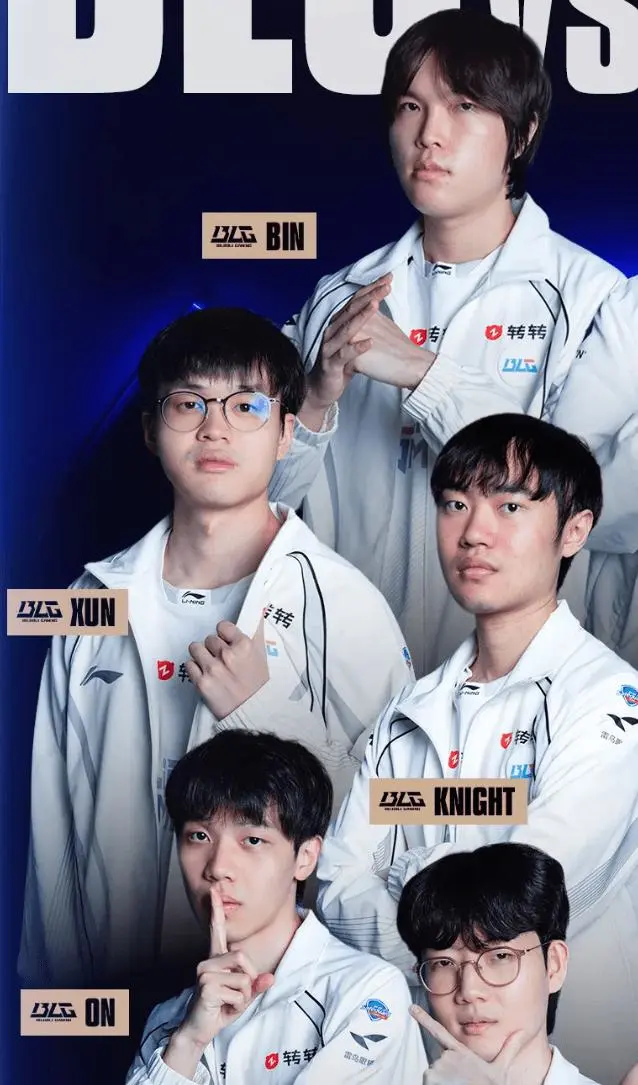
A five-person BLG team poster, a three-person dance clip, and one instruction: put all five into the same Can I Ride Dance. This Kling 4.0 Reference case uses the poster for the people and white team outfits, while the video supplies the choreography, room and camera. The result is a 10-second vertical League of Legends fan edit made with AI—not footage of the players performing the dance.
AI-generated result
Give the team photo and dance video different jobs
The useful trick is to separate who appears from how they move. Asking for “BLG doing the Can I Ride Dance” alone leaves both decisions open. Here, the two uploaded references make the request concrete:
| Input | What it supplies | What to leave behind |
|---|---|---|
@Image1: five-person BLG poster | Five distinct faces, hairstyles, glasses and white team jackets | Poster background, lettering, name labels and portrait poses |
@Video1: three-person dance clip | Dance sequence, rhythm, indoor setting and continuous camera | Original performers and their brown suits |
BLG means Bilibili Gaming, the League of Legends team. The supplied poster is the identity reference for this fan edit; it is not a claim about the team's current roster. Bilibili also identifies BLG as its esports team in its investor materials.
Use images and video you have permission to reuse. Keep the final clip clearly labeled as an unofficial AI fan edit, especially when sharing it outside a fan community.
Set up Kling 4.0 Reference on WeShop
Open Kling on WeShop, start a task and select Kling 4.0 Reference. Upload the team poster as Image 1 and the dance clip as Video 1. Confirm both are attached before generating: describing a dance in text does not replace uploading the motion reference.
Use the settings recorded in this case:
| Setting | Case value |
|---|---|
| Model | Kling 4.0 Reference |
| Duration | 10s |
| Resolution | 1080p |
| Aspect ratio | 9:16 |
| Quantity | 1 |
| Inputs | One image and one video |
These are the case settings, not a guarantee of the same result on every run. Check the current credit quote in your own task before generating. The WeShop Kling 4.0 model page explains the available input routes; this example uses Reference, with both image and video inputs.
Tell Kling how three dancers become five
Replacing three dancers with five people requires more than a face-replacement instruction. The prompt must establish a new group count, map each portrait to a position and give the wider formation room to move.
The original prompt uses visual positions in the poster rather than relying on recognition of player names:
| Poster position | Requested dance position |
|---|---|
| Uppermost portrait, hands clasped | Center lead |
| Middle-left, round glasses | Immediately left of the lead |
| Middle-right, no glasses | Immediately right of the lead |
| Lower-left, finger near lips | Far left |
| Lower-right, round glasses | Far right |
It also says that the poster contains five different people, then rules out duplicated faces, merged identities and missing members. A shallow V formation is requested, with slightly wider framing to fit five bodies. Treat these as instructions to inspect against the output: this result changes formation as the dance develops, rather than locking every person to one screen position.
Reuse the exact Can I Ride Dance prompt
This is the full prompt from the completed case. Keep the @Image1 and @Video1 references matched to the correct uploads. If you replace the poster, rewrite the portrait-to-position descriptions to match your own image.
Use @Video1 as the choreography, rhythm, room and camera reference. Replace its three brown-suited dancers with ALL FIVE distinct adult men shown in the single composite team poster @Image1, adding two dancer positions so that exactly five people dance together for the full 10-second clip. @Image1 contains five different people, not different views of one person. Do not retain any original dancer, duplicate a face, merge two identities, or omit anyone.
Fixed mapping and formation: the uppermost man in the poster with medium-length black hair and clasped hands is the center lead. The man at middle-left with round glasses is immediately to the lead's left. The man at middle-right with short black hair and no glasses is immediately to the lead's right. The lower-left man with a finger near his lips is at the far left of the group. The lower-right man with round glasses and side-parted black hair is at the far right. This left-to-right order stays unchanged. Arrange them in a shallow five-person V, with the center lead slightly forward and the outer two slightly behind, leaving enough space between bodies to see all five faces and hand gestures. Widen the original framing only as much as necessary to fit five full-body dancers, retaining the vertical composition and continuous fixed camera.
Match each man's own facial shape, skin tone, black hairstyle, glasses where present, and slim-to-average physique from @Image1. Dress each in the white team zip jacket and white shirt visible in the photo, preserving visible black piping, sleeve details and small team marks, with matching white athletic trousers and white sneakers for lower-body areas not shown. Keep the faces and costumes stable throughout. Use the photo only for the five people and their outfits: do not copy the poster background, large lettering, beige name labels, printed names, layout, posed hand gestures or text overlays.
Have all five perform the same Can I Ride dance from @Video1 in synchronized timing: relaxed knee bounce, turning an imaginary steering wheel with both hands, shoulder movement, thumb-over-the-shoulder gesture and the remaining source hand and leg moves, matching the source beat and sequence rather than inventing a different dance. Extend the original choreography naturally to the two new positions. Preserve the original indoor dance setting, wooden floor, glass wall, ceiling lights, color and lighting, with physically plausible contact shadows. Photorealistic movement, natural expressions, correct hands and legs, no body intersections. One continuous shot, no cuts, no crowd, no additional people, no brown suits, no new captions. Preserve the original song and beat timing.
The sentence requesting the original song is part of the submitted prompt. It is not a verified promise that Kling preserves an identical soundtrack. Preview audio separately before sharing; this case's visual comparison does not establish soundtrack fidelity.
Compare the output with the dance reference
Reference video
Generated fan edit
The generated clip shows five white-clad performers in the recognizable wood-floor, glass-wall room. The knee bounce, steering-wheel-style hand movement and later arm gestures follow the reference's broad action sequence. The group reshapes around a forward-moving lead, so the output is a generated reinterpretation of the reference rather than a frame-for-frame copy.
Before keeping your result, watch the entire clip and check:
- Five people throughout: no disappearing member, extra dancer or repeated face.
- Recognizable identities: inspect each face and glasses during movement, including the people at the edges.
- Readable choreography: compare the order of knee, shoulder and hand movements with the source.
- Clean details: look at overlapping arms, fingers, foot contact and small jacket marks. A successful generation status does not certify exact likeness or logo accuracy.
If the model keeps only three dancers, put the five-person count and two added positions at the beginning of the prompt. If it copies the poster layout, clarify that the image supplies people and outfits only. If faces become hard to distinguish, use a clearer identity reference and leave more space between performers; review the new output rather than assuming the wording fixes it.
Make your own BLG Can I Ride Dance fan edit
The reusable workflow is one identity poster plus one choreography clip. Keep the source roles explicit, assign all five people and use the recorded vertical-video settings as your starting point. For a League of Legends fan video, the edit's appeal comes from the recognizable team styling and shared dance—not from presenting the scene as real player footage.
You can try it directly using the tool on the right.