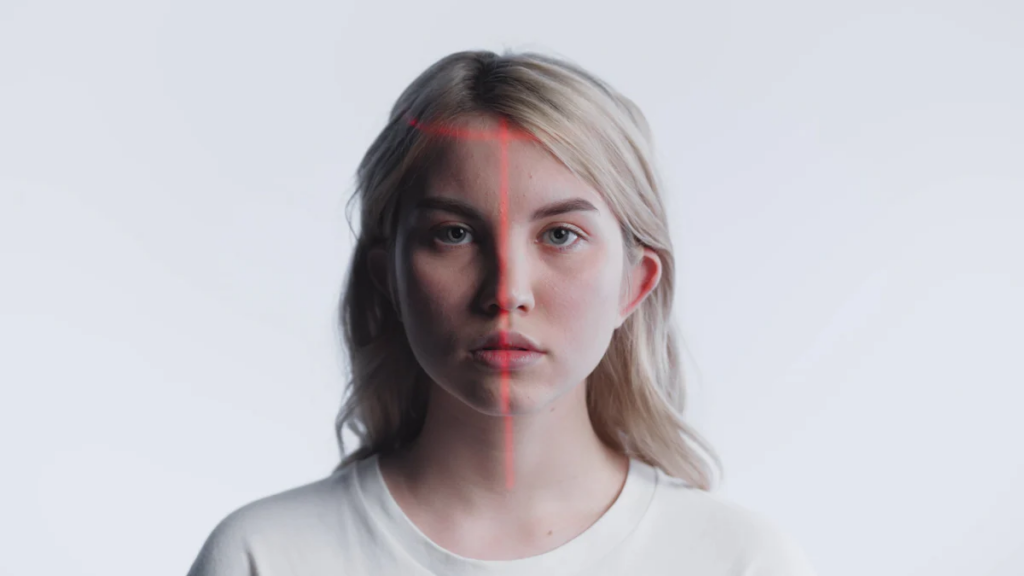
An AI Face Attractiveness Tool can turn one portrait into a beauty score, symmetry report, face-shape label, or facial-proportion analysis.
Some tools actually produce a beauty score. Others measure face shape or facial attributes. A few are developer frameworks rather than consumer beauty tests.
That difference matters.
If one tool gives you an 82 and another calls your face oval, they are not disagreeing. They are solving different problems.
More importantly, an attractiveness score is not an objective measurement of a person’s beauty. Facial preferences vary between people and cultures, even when some features such as symmetry or averageness show broader patterns.
So the useful question in 2026 is no longer:
Which tool knows who is the most attractive?
A better question is:
What does each tool actually measure, and how stable is the result when the photo changes?
What Each AI Face Attractiveness Tool Actually Measures
The old version of this article compared Face++, AI Face Analyzer, Reversely, and DeepFace as if they were direct competitors.
They are not.
| Tool | What it actually focuses on | Is it a direct attractiveness score? |
|---|---|---|
| Face++ | facial attributes and Beauty Score API | Yes |
| Consumer AI Face Analyzer | symmetry, ratios, score cards, depending on the app | Sometimes |
| Reversely Face Shape Detector | face-shape classification and facial proportions | No |
| DeepFace | face recognition and facial attributes | No |
Face++ currently lists Beauty Score as part of its facial-analysis technology. Its official description says the system can calculate beauty scores for detected faces from different scoring perspectives.
Reversely, meanwhile, analyzes facial landmarks and proportions to classify face shape into categories such as oval, round, square, heart, oblong, and diamond. It is useful structural information, but that is different from answering “how attractive is this face?”
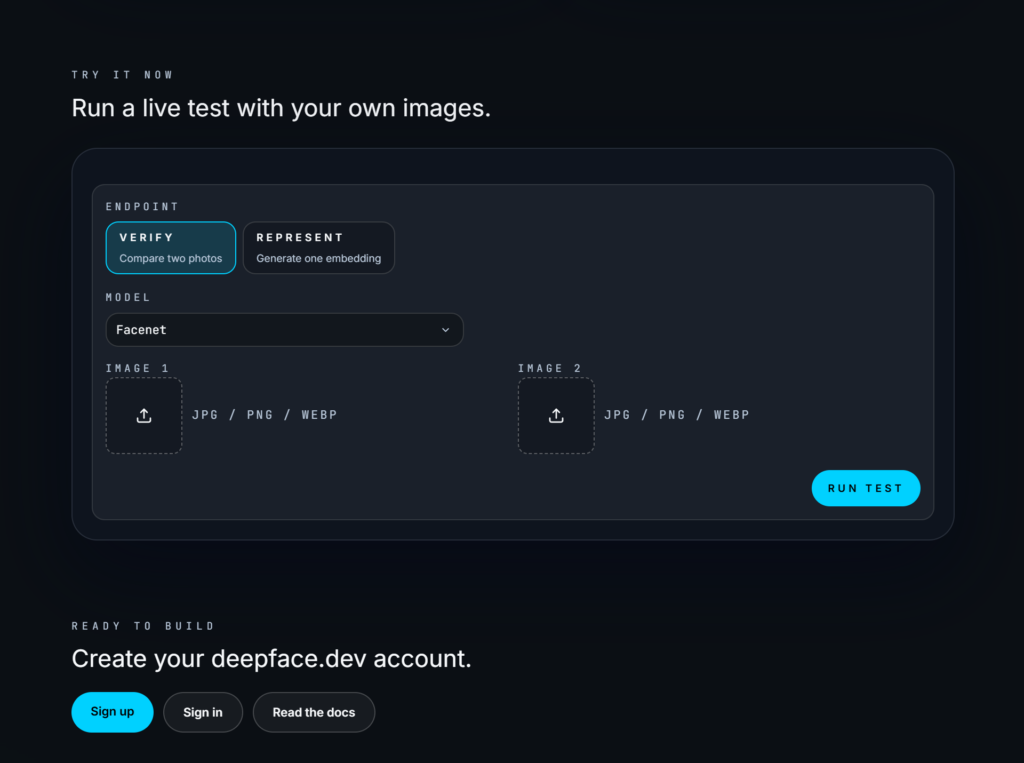
DeepFace is different again. Its current official project supports face verification plus attributes such as age, gender, emotion, and race. Attractiveness is not one of the listed analysis actions.
That distinction already fixes one of the biggest problems in the old article.
Why an AI Face Attractiveness Tool Is Not a Beauty Verdict
A score looks precise because it gives you a number.
For example:
78 / 100
That does not mean attractiveness has suddenly become an objective physical measurement.
The number reflects the rules, training data, facial landmarks, ratios, and scoring system used by that specific tool.
Another system may use different inputs and produce a different score.
Research on human judgments points to the same problem. People often show some agreement about facial attractiveness, but the specific features that influence ratings can vary across cultures and individuals.
Therefore, treat an AI face attractiveness tool more like a measurement framework.
It can tell you:
- what its model notices
- how one photo compares with another inside that system
- which facial ratios or symmetry features it emphasizes
- whether the result changes under different photo conditions
It cannot tell you how every person will perceive a face.
Test an AI Face Attractiveness Tool for Repeatability
Before comparing two tools, test one tool against itself.
Use the same adult face and change only the photo conditions.
For example:
A — Neutral Front Portrait
Use soft light, a straight camera angle, and a neutral expression.
Treat this as the baseline.
B — Strong Side Light
Keep the same person and framing. Change only the direction of the light.
Now see whether the score moves.
C — Natural Smile
Return to similar lighting, but change the expression.
Again, record the result.
D — Slight Three-Quarter Angle
Keep everything else as similar as possible. Turn the face slightly.
If one AI face attractiveness tool produces very different results across these four images, the score is responding to more than the person’s underlying facial structure.
That is useful information.
It tells you how sensitive the system is to photography.another. For this reason, Reversely should not be ranked against direct scoring tools on “beauty accuracy.”
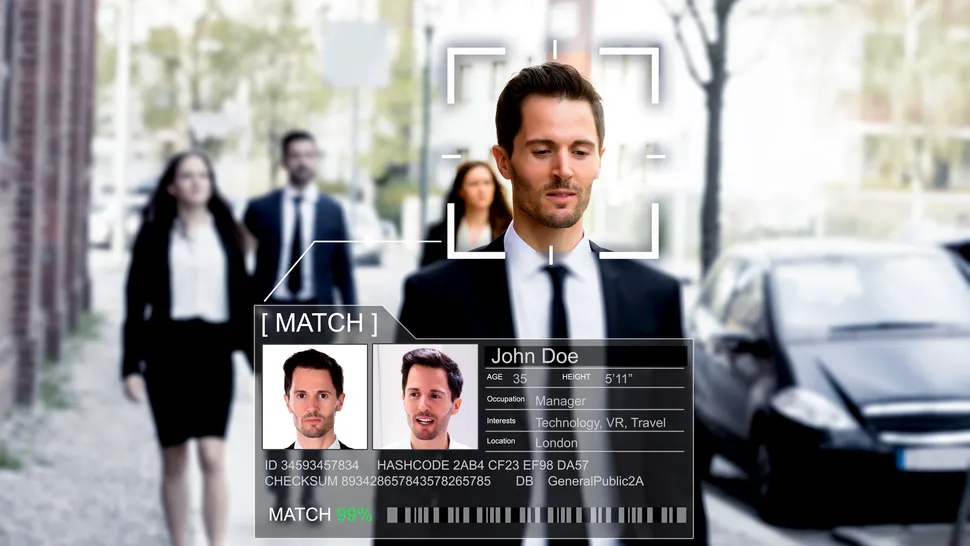
Face++ Is the Clearest Match for an Actual Beauty Score
Of the tools in the original article, Face++ remains the clearest example of an actual programmatic beauty-scoring system.
Its current facial-analysis offering includes facial landmarks, attributes, head pose, emotion, skin status, image quality, and Beauty Score. Face++ also provides APIs rather than operating only as a simple consumer selfie quiz.
That makes it more relevant to developers or businesses building facial-analysis features.
However, the score still needs to be interpreted correctly.
Face++ describes a Beauty Score produced by its system. It does not establish a universal standard of attractiveness.
The old article also claimed that Face++ achieved a 0.08% error rate and then used that number as proof that its attractiveness score was the most accurate.
I would remove that claim entirely.
The current Face++ Beauty Score documentation confirms the feature, but it does not support using a 0.08% figure as a universal beauty-rating error rate.
What to Check When Testing Face++
Do not focus only on the final number.
Record:
Photo condition
front / angled / bright / dim
Expression
neutral / smiling
Face visibility
full forehead and jaw visible or partially covered
Returned score
Then repeat the same image once.
A useful scoring tool should give you a result you can understand and reproduce, not simply an impressive-looking number.
Consumer AI Face Analyzer Tools Need More Careful Comparison
“AI Face Analyzer” is now a broad product category rather than one standardized system.
Different apps may combine:
- symmetry
- golden-ratio measurements
- facial landmarks
- face shape
- skin appearance
- an overall attractiveness score
For example, current consumer products exist that generate face scores from symmetry and facial measurements. Fotor also currently offers a consumer-facing attractiveness test with separate dimensions for beauty, handsomeness, face shape, symmetry, and skin smoothness.
The problem is that two apps can use the same label—AI Face Analyzer—while applying different scoring rules.
So avoid statements such as:
AI Face Analyzer is 95% accurate.
Unless that exact product publishes a clearly defined benchmark for that exact scoring task, the number does not tell readers very much.
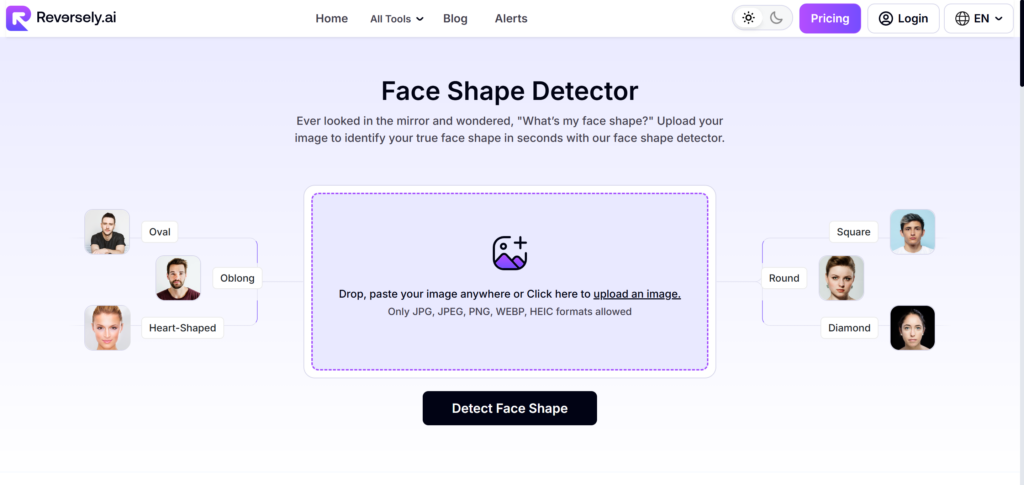
Reversely Is More Useful for Face Shape Than Attractiveness
Reversely should stay in the article, especially if the existing outbound link is important.
However, its role needs correcting.
Its current Face Shape Detector analyzes facial landmarks and measurements such as face length, forehead width, cheekbone width, and jawline width. It then assigns the closest face-shape category.
That is useful for questions such as:
Is this face closer to oval or heart-shaped?
or:
Which hairstyle or glasses shape might suit this facial structure?
It is much less useful for:
Is this person objectively attractive?
Those are different questions.
Face shape is one visual characteristic. It is not an attractiveness score.
DeepFace Should Not Be Ranked as an Attractiveness Tool
This is another important correction from the old article.
DeepFace is an active open-source Python framework for facial recognition and facial attribute analysis. Its current analysis functions include age, gender, emotion, and race predictions, along with face verification and representation workflows.
It is technically interesting.
However, it does not currently list attractiveness scoring as one of its standard analysis actions.
The old article quoted DeepFace accuracy figures and then placed those numbers inside an attractiveness comparison.
That mixes different tasks.
For example, a model can be accurate at face recognition or age estimation without proving anything about the validity of a beauty score.
So DeepFace should remain in this article as a useful comparison point:
facial analysis ≠ attractiveness scoring
That distinction is more informative than forcing every tool into the same ranking.
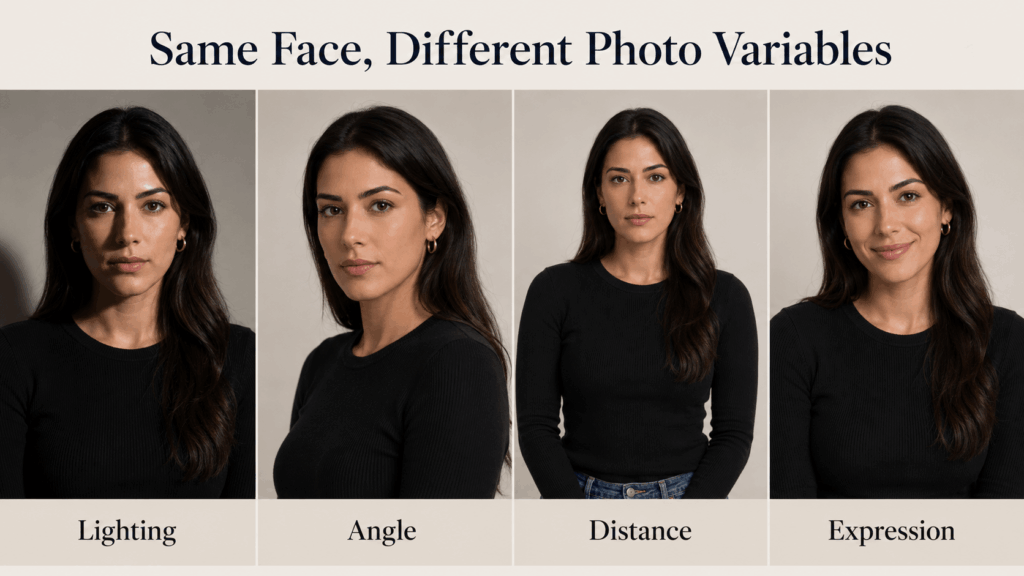
Why an AI Face Attractiveness Tool Can Give Different Results
This is where the comparison becomes more useful.
AI face attractiveness tools does not receive your face directly.
It receives an image of your face.
That image contains other variables.
Lighting
Strong side light can change the visible jawline, cheekbone contrast, eye shadows, and skin appearance.
Camera Angle
A small head turn changes the apparent distance between facial landmarks.
Camera Distance
A close phone camera can change perspective. The nose may appear larger while the ears and sides of the face appear farther away.
Expression
Smiling changes the mouth, cheeks, eyes, and sometimes the apparent width of the lower face.
Hair and Obstruction
Bangs, glasses, hair, or hands can cover landmarks that the system wants to detect.
Filters and Retouching
Skin smoothing, reshaping, or beauty filters can alter the exact visual information being scored.
That is why testing photography conditions is often more useful than debating whether a score of 76 or 81 is “correct.”
A Better Way to Compare an AI Face Attractiveness Tool
Do not upload your best selfie to one tool and a casual phone photo to another.
Use one controlled image file.
Then keep a simple test sheet:
| Test | Tool A | Tool B | Tool C |
|---|---|---|---|
| Same original image | score/result | score/result | score/result |
| Same image uploaded again | score/result | score/result | score/result |
| Side-light version | score/result | score/result | score/result |
| Smile version | score/result | score/result | score/result |
Now you can ask better questions.
Repeatability:
Does the same file return the same or similar result?
Sensitivity:
How much does lighting or expression change it?
Transparency:
Does the tool explain what it measures?
Usefulness:
Does the breakdown help more than the final score?
That last question matters most.
A tool that gives you an unexplained 8.4/10 may be less useful than one that shows symmetry, face shape, or individual facial ratios.
Turn the Analysis Into a Visual Test
A face score becomes more useful when it leads to a testable visual question.
For example:
Does softer lighting change the portrait more than facial symmetry does?
Would bangs change the visible proportions around the forehead?
How does warm versus cool hair color change the overall contrast around the face?
Those are things you can actually see.
This is where WeShop fits better than pretending it provides an objective attractiveness verdict.
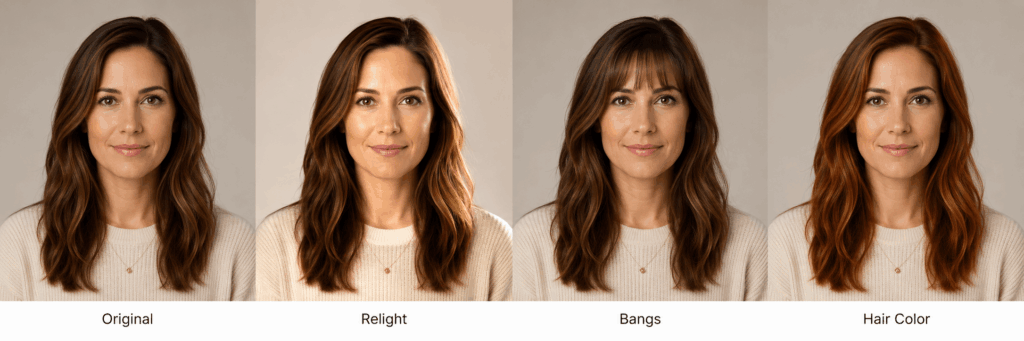
For example, the current WeShop toolset includes Relight, Bangs Filter, and AI Hair Color Changer. They can be used to create controlled visual variations while keeping the original portrait as the reference.
A useful experiment might be:
Original → Soft Relight → Bangs → Different Hair Color
Then compare the images visually.
Do not ask:
Which version makes this person objectively more beautiful?
Instead ask:
Which version creates the strongest portrait for the intended style, campaign, or profile image?
That is a much more practical use of AI.
So Which AI Face Attractiveness Tool Gives the Best Result?
There is no useful single winner because these tools do not perform the same job.
Choose Face++ when you specifically need a developer-facing Beauty Score and facial-analysis API. Face++ currently offers both facial attributes and a dedicated Beauty Score capability.
Choose a consumer attractiveness analyzer when you mainly want a quick score or visual report for personal curiosity. However, read the methodology before treating the number seriously. Current consumer tools vary widely in what they include.
Choose Reversely when your actual question is face shape and facial proportions rather than attractiveness.
Choose DeepFace when you are building or studying facial recognition and attribute-analysis workflows. It should not be presented as an attractiveness scorer.
The old version of this article declared Face++ the winner.
The updated version makes a different recommendation:
Choose the tool by what it measures, then test how stable the result is.
A precise-looking number is not automatically a meaningful number.
Before You Trust an AI Face Attractiveness Tool Score
Use this short check:
- Was the photo clear and front-facing?
- Were filters or heavy retouching removed?
- Does the tool explain what it measures?
- Does the same photo produce a repeatable result?
- Is the output a beauty score, face-shape result, or another facial attribute?
- Are you treating the score as one model’s output rather than a judgment of personal worth?
If those questions are clear, the result becomes easier to interpret.
If they are not, do not give the final number more authority than it deserves.
Research continues to show that facial preferences include both shared patterns and meaningful cultural and individual differences. No single AI score captures all of that.
Go to WeShop AI For Exploration: