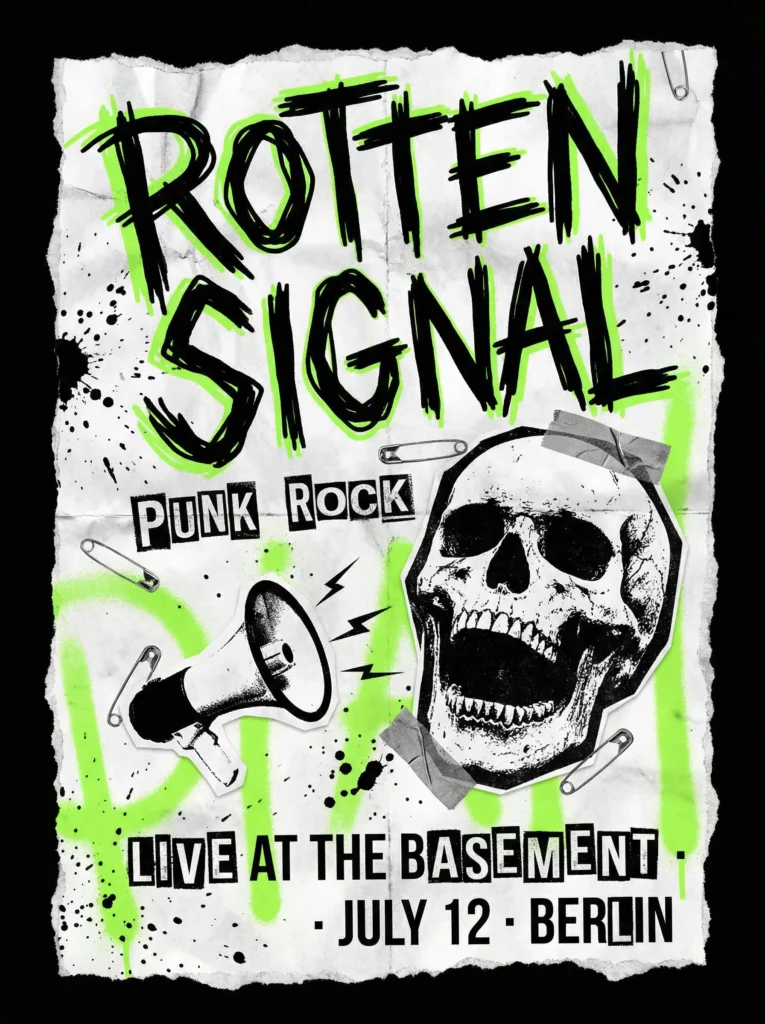
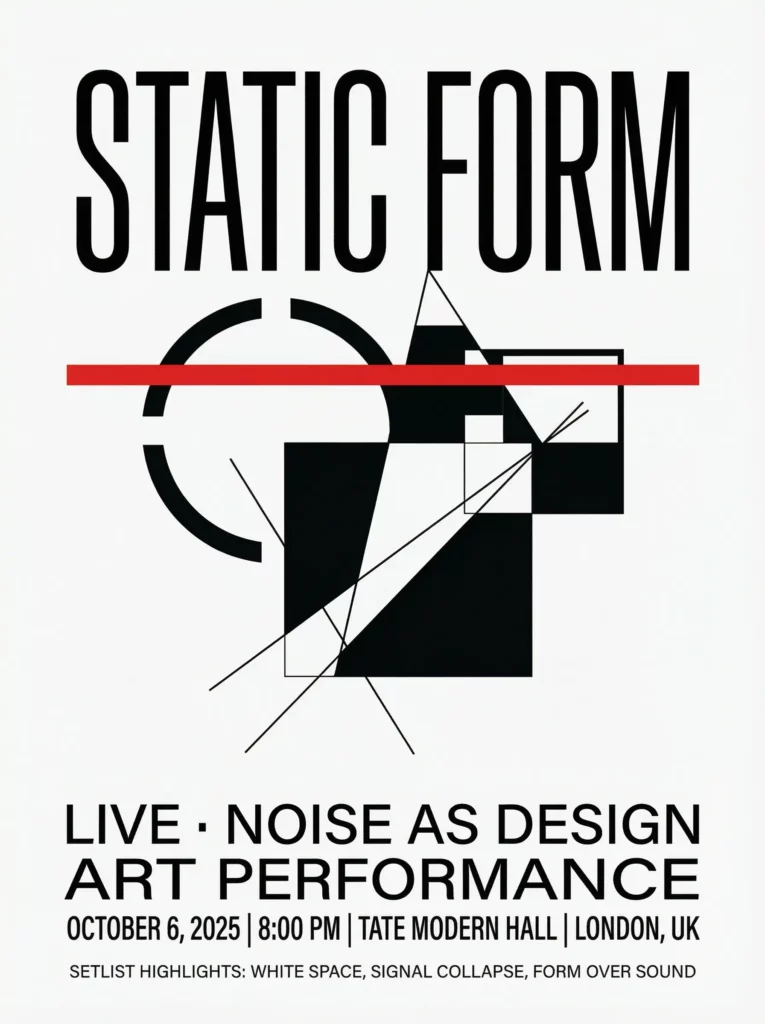
An AI poster generator enters the story long before the doors open. The poster may first appear on a phone at midnight. Later, it might be taped to a record-shop window, half hidden by another flyer. In both places, it gets only a moment to earn attention.
That moment is not about showing off every design trick. It is about making somebody think, “Wait—who is playing, and when?” A good gig poster creates that pause. Then it rewards the closer look with the venue, support act, doors time, and ticket details.
WeShop AI’s AI Poster Generator can turn a written brief into a poster concept. You can describe the copy, colors, layout, mood, and the role of an uploaded image. Still, the tool should not be asked to invent the show. The date, venue, lineup, and ticket terms belong to the promoter or artist.
This is where live-music poster design becomes interesting. The facts cannot move, but almost everything around them can. Type can shout or whisper. Space can feel tense or open. Texture can suggest a photocopied basement flyer, a clean club grid, or a screen-printed tour relic.
The Poster Has Three Seconds to Start a Conversation
Imagine walking past the poster rather than studying it on a laptop. What survives? Ideally, the artist name lands first. The date and venue follow. Everything else can wait until the viewer stops.
This does not mean the smaller copy is unimportant. Instead, it means the information has rhythm. A support act is not the same volume as the headliner. “Doors at 7” does not need to fight the band name. Meanwhile, a ticket note can sit quietly, but it cannot disappear.
The order may change with the event. For example, a well-known band can lead with its name. By contrast, a recurring club night may lead with its series identity. A last-minute local show may need the date to work harder. Therefore, before generating anything, decide what the poster should say in its first breath.
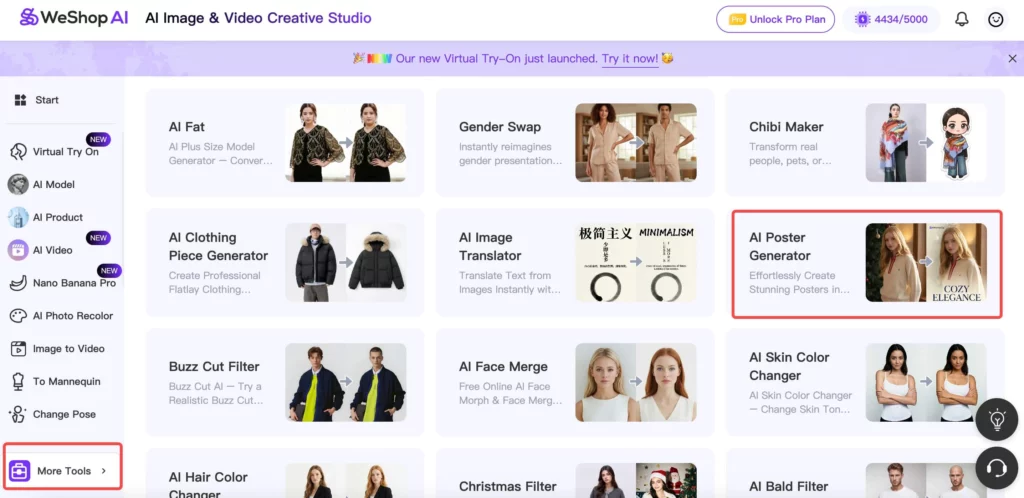
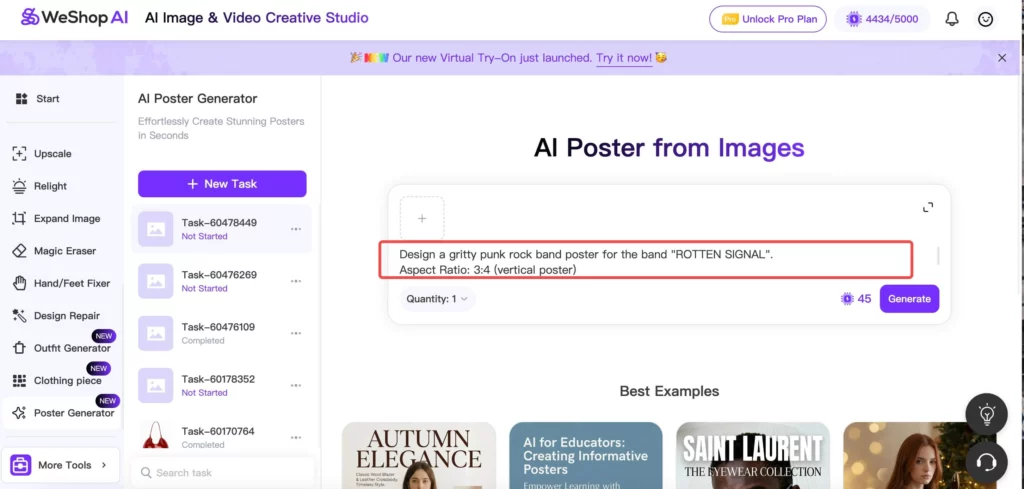
Once that answer is clear, open AI Poster Generator in WeShop AI. Begin with the show, not with a bag of style words. menus.
Feed the AI Poster Generator Facts Before Vibes
“Dark, raw, underground, electric” may describe the night, but none of those words will get a fan to the venue. Instead, start with a small block of verified event copy. Treat it like the label on a record: it can be arranged, but it cannot be rewritten by accident.
For example, our fictional show will follow the article from here:
NIGHT GLASS
WITH RIVER STATIC
FRIDAY, OCTOBER 18
DOORS 7:00 PM · SHOW 8:00 PM
HALL B · BERLIN
TICKETS AT VENUE
The names and details above are fictional. However, in a real brief, every line should come from the promoter’s approved source. Put the exact phrases in quotation marks, and tell the AI poster generator to add no other text. That last instruction matters. Otherwise, AI may invent small sponsors, mystery prices, or decorative dates when an empty corner looks lonely.
So, resist the urge to let the model “complete” missing information. It should not calculate the weekday, guess the venue address, or create a ticket link. If the show changes, fix the source block first. Otherwise, an old doors time can survive through several handsome drafts.
In addition, locking the facts makes style easier to explore. You can change the type, texture, image, and color without wondering whether the content changed at the same time.
Genre Is a Starting Point, Not an Art Direction
Ask for “a punk poster” and you may get torn paper, black tape, and a distressed font. Likewise, ask for “an electronic poster” and the screen may glow blue before the sentence is finished. These shortcuts are not always wrong. However, they are too familiar to tell us much about this particular show.
Listen for behavior instead. Is the music clipped and percussive? Then tight spacing, repeated type, and hard angles may carry that rhythm. Is it dense and abrasive? In that case, a heavy black image field could work, provided the event copy remains untouched. If the sound is spacious, the poster may need more air rather than more effects.
Even warmth has options. For instance, an acoustic set does not require leaves, coffee cups, or a fake rustic wall. Tactile paper, a human-scale photograph, and two restrained colors may say more. Likewise, electronic music does not automatically need neon. A modular grid, spectral blur, or precise metallic light can feel synthetic without slipping into cyber wallpaper.
Therefore, the useful question is not “What does this genre look like?” It is “What does this performance do to a room?” That answer gives the AI poster generator something specific to translate.
A Lived-In AI Poster Generator Prompt
Create a vertical live music poster for the fictional band “NIGHT GLASS” with support from “RIVER STATIC.” Show only this event copy: “FRIDAY, OCTOBER 18,” “DOORS 7:00 PM · SHOW 8:00 PM,” “HALL B · BERLIN,” and “TICKETS AT VENUE.” Use a post-punk visual system with condensed black typography, one cobalt shape, rough photocopy texture, and strong negative space. Make “NIGHT GLASS” the largest element. Keep the date and venue readable at thumbnail size. Use no photos of real musicians, no logos, no sponsors, no prices, and no other text.
The prompt leaves room for surprise, but it does not surrender the show. Texture, shape, and balance can move. Meanwhile, the copy and reading order stay fixed. That is a much healthier relationship with an AI tool than asking it to “make something cool” and hoping the date survives.
Let the First AI Poster Generator Draft Be Wrong
The first draft has one valuable job: it reveals what your brief failed to say. Perhaps the band name looks perfect but the venue has vanished. Or maybe the image captures the sound, yet the whole design turns to mush at phone size. Either way, that is useful information, not a reason to start over blindly.
So, change one thing at a time. If the artwork is too loud, lower its contrast or give the copy a clean strip. If the hierarchy is flat, enlarge only the first-read element. If the mood is wrong, change the material language rather than rewriting the date, layout, image, and type in one sweep.
Then perform the unglamorous check that saves the poster. Read every letter and number against the approved show source. Check the artist, support act, date, doors time, show time, venue, city, ticket note, and any access information. One wrong digit is enough to send somebody to an empty room.
Next, make the design tiny. A phone thumbnail is brutally honest. The artist, date, and venue should still create a path. If the artwork arrives before the event name, the balance is not finished.
Finally, look beyond the screen. Confirm that the artist photo, logo, illustration, texture, and venue marks are yours to use. Do not ask for the exact style of a living designer or clone a known poster. The image may be new, but the responsibility to publish it is still human.
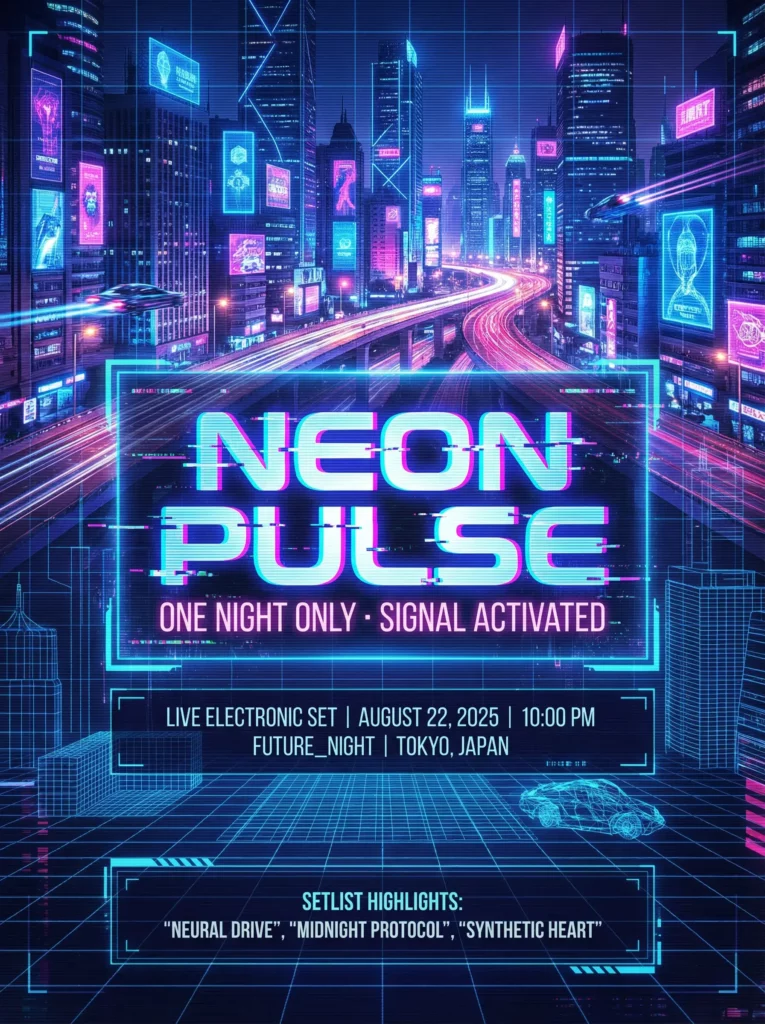
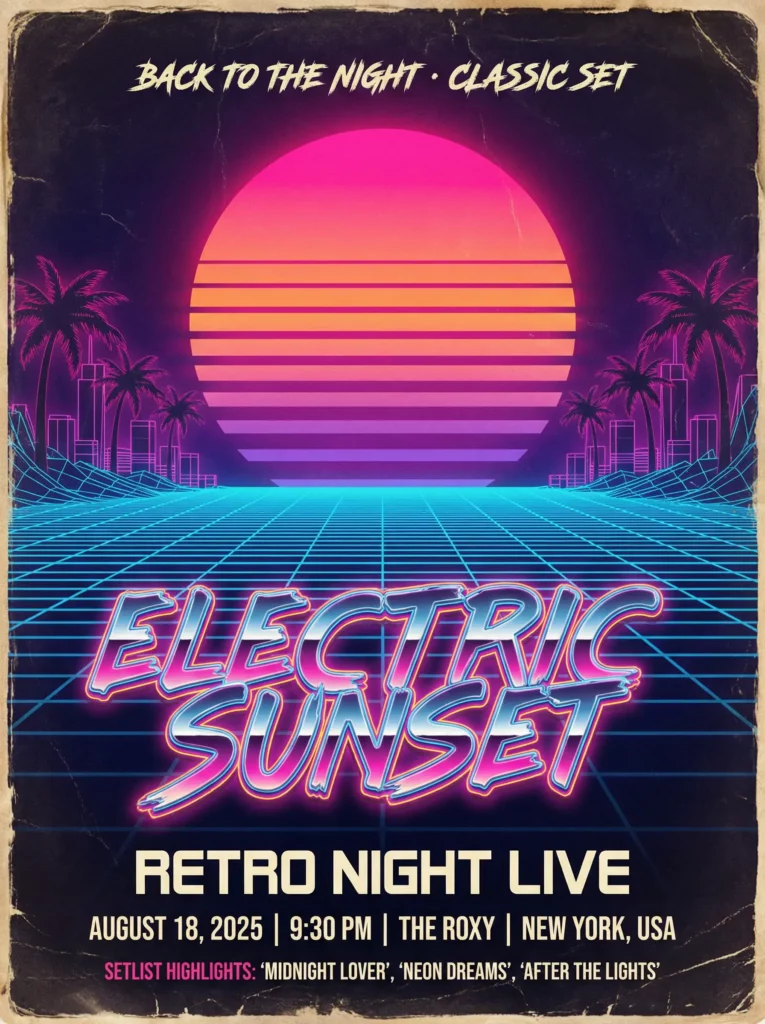
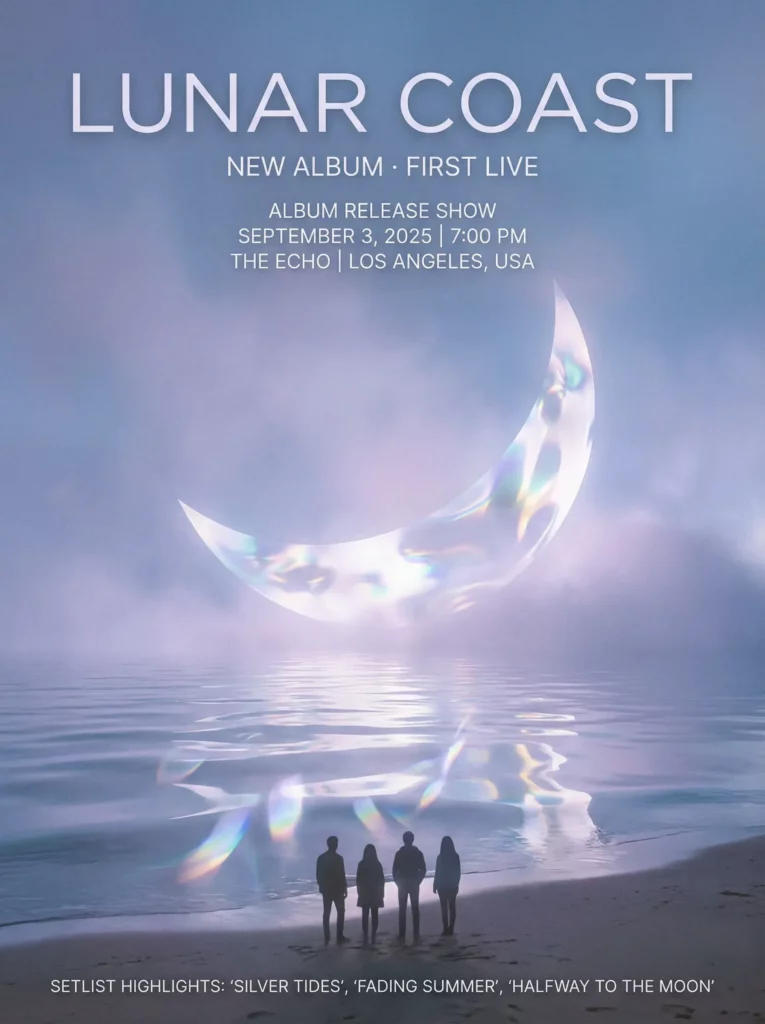
One Night Can Leave Three Different Visual Memories
Keep the NIGHT GLASS information block unchanged and imagine three versions on the same wall.
The first feels like a post-punk flyer rescued from a rehearsal-room floor. It uses one or two inks, condensed type, a hard crop, and photocopy grain. Yet the roughness stops before it reaches the date and venue. The poster feels handled, not broken.
Next, the second belongs to a precise electronic night. A modular grid holds the copy. A spectral blur crosses one edge. Metallic light replaces the familiar blue-and-purple neon haze. It feels synthetic because the structure is controlled, not because every object glows.
Finally, the third is quieter. One odd object or location becomes the visual clue. A contact-sheet crop and a large margin leave room for doubt. This can suit an indie or dream-pop show, but only when the image connects to the music. After all, a random sunset is not atmosphere; it is filler.
All three directions can work because the show information does not drift with the mood. They are not templates for three genres. They are three different memories of the same night.
When AI Poster Generator Lettering Goes Rogue
Sometimes the most exciting draft contains the worst spelling. The image feels alive, the type has attitude, and the venue name has quietly gained an extra letter. This is the moment to choose usefulness over attachment.
First, try a focused correction. Quote the exact replacement and name the only line that may change. Then ask the AI poster generator to preserve the artwork, color, crop, and remaining copy. If that works, excellent. However, if it does not, stop gambling with the event details.
Even then, the poster can still be valuable as artwork or a layout reference. Rebuild the critical copy as a controlled type layer before release. That is not a failure of the creative process. Instead, it is normal production judgment.
Human type becomes even more important with a long lineup, ticket URL, sponsor row, access note, or several tour dates. AI can set the temperature of the poster. A designer should protect the information that gets people through the door.
Let One Master Poster Travel with the Show
A poster rarely lives in one rectangle. The tall version goes into a venue window. The square version enters a feed. A story has interface controls crowding the top and bottom. An event page may need a wide image, while the day-of-show post needs the time and address to move forward.
These are not simple crops. Each version is another performance of the same design. Keep the type family, color logic, texture, and visual anchor. Then let the information order adjust to the space.
For example, the square social post may only need the artist, date, and venue. The print poster can hold the support act, ticket note, and access line. A lineup announcement needs room for names. Meanwhile, the day-of-show version should make “tonight,” the doors time, and the location impossible to miss.
Every format returns to the same approved event source. That is how a set feels coherent without forcing one layout into places it was never built to survive.
Make a Poster Worth Pulling Off the Wall
The best music posters do more than announce a date. They preserve a small piece of the night before it happens. Someone may save the image, photograph it on the street, or take the paper version home after the show.
So, begin with the true event copy. Decide what the poster says in its first breath. Then describe how the performance feels in a room, and let WeShop AI’s AI Poster Generator propose a visual answer.
Keep the strange crop, the rough ink, or the unexpected color if it belongs to the music. Correct the venue name. Check the time. Respect the image rights. Make each format earn its own layout.
Ultimately, AI can widen the visual possibilities. The artist, promoter, or designer still decides what deserves to represent the show. That is not extra work. It is the part that makes the poster feel alive.
Go to WeShop AI For Exploration: